You don’t want to look like you’re covering gray. You want to look like someone who has great hair, full stop. That’s the real goal behind most gray-blending appointments, and it’s exactly why the question of whether balayage or highlights is better for blending gray hair naturally matters more than people realize. Both techniques work with lightener on the same head of hair, but they interact with gray in completely different ways. Choose the wrong one for your gray pattern and you’ll be back in the chair in six to eight weeks, staring at a hard line of demarcation that announces your roots louder than the gray ever did.
At Harlow Beauty and Hair Salon on Burnet Road in North Austin, every gray-blending appointment begins with a thorough consultation before any formula is mixed. Harlow’s colorists map where gray is concentrated across the scalp, dense at the temples, scattered through the crown, clustered at the hairline, because that pattern shapes technique selection, placement depth, and developer strength more precisely than any blanket rule. Gray distribution is a primary factor alongside texture, desired lift, and porosity, and treating it like a one-size-fits-all decision is how people end up with results that don’t hold up past month two.
This article covers how each technique behaves at the root versus the mid-shaft, which gray percentages favor which approach, how grow-out actually looks over time, what formulas make the blend work, and what to bring to your consultation so you leave with a plan that fits your hair and your schedule.
Is balayage or highlights better for blending gray hair naturally?
Balayage is painted freehand, typically starting at the mid-shaft and becoming progressively heavier toward the ends. It rarely reaches the scalp, which means the root zone stays largely natural. Foil highlights are a different story: the hair is sectioned, wrapped in foil, and saturated from the root outward. That root access is the single most important mechanical difference when gray is the target. If your gray is concentrated at the hairline or crown, foil placement reaches it directly; balayage, by design, mostly doesn’t.
The foil itself also changes the chemistry. Trapping heat inside the foil accelerates lightening and produces brighter, more uniform results with higher contrast. Balayage processes in open air with no heat assist, which creates a softer gradient and less intensity near the root. For gray hair, that intensity difference matters: more lift near the root means more visible blending where gray tends to cluster, while softer lift creates a gentle camouflage that lets gray emerge gradually rather than disappearing completely.
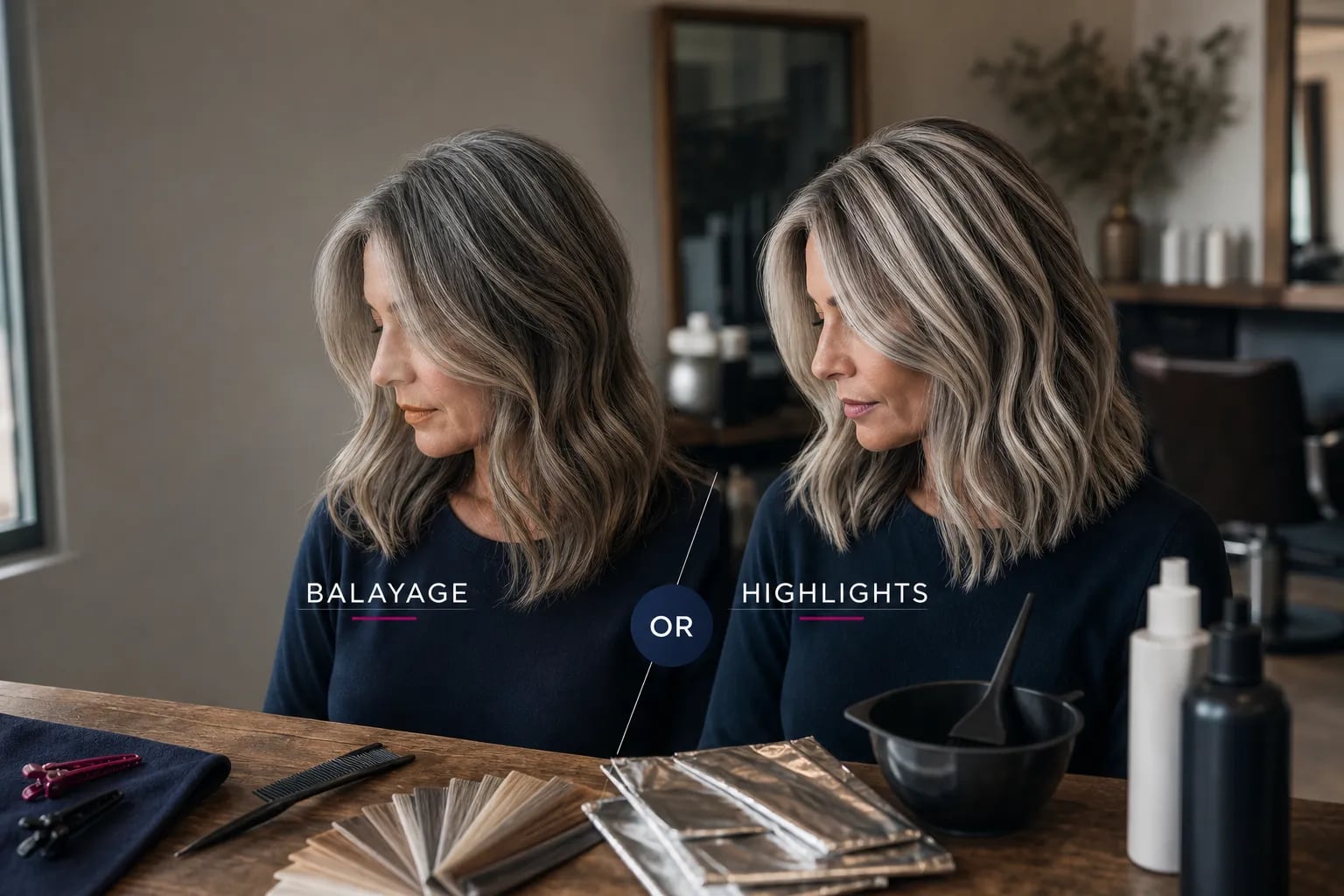
The finished results reflect this directly. Foil highlights produce defined, consistent ribbons of light with a regrowth line that becomes visible as natural hair grows back in. Balayage creates a sun-kissed gradient where gray can re-emerge softly without a sharp line of contrast. Neither outcome is wrong, they serve different gray-blending goals, and the right choice depends entirely on what your gray pattern looks like and what result you’re actually after.
Matching the technique to your gray percentage and hair texture
When gray coverage is under 30%, balayage is usually the stronger fit. Scattered grays can be softened and woven into a dimensional blonde or brunette blend without needing full root coverage, and the result looks intentional rather than painted. Face-framing highlights are worth considering here as well: fine, bright strands placed around the hairline add dimension that integrates lighter grays seamlessly into the overall color. The grow-out on both approaches is forgiving because there’s no hard color-to-natural line waiting to emerge.
Above 50% gray, balayage alone tends to leave too much unblended gray at the root because it simply doesn’t deposit color in that zone. A hybrid approach becomes practical at that density: partial foils through the crown combined with balayage through the mids and ends gives stronger blending where gray is most concentrated while preserving the soft, graduated effect through the lengths. At 90% gray, if the goal is meaningful coverage rather than a purely transitional look, highlights are almost always the right tool.
Hair texture shifts the equation as well. Fine hair can lose the dimension of balayage because there isn’t enough density to show the transitions clearly. Foil highlights create visible brightness on fine strands that registers more cleanly against thinner sections. Wavy and thick hair is where balayage genuinely excels: the natural movement and density catch painted dimension exactly as intended, making the color look richer and more deliberate without a heavy-handed application.
Grow-out reality: how balayage and foil highlights age differently
Because balayage doesn’t reach the root, there’s no hard contrast line waiting to surface as new growth comes in. Gray re-emerges gradually, softening into the painted dimension below it rather than announcing itself as a separate zone. Most clients with gray hair and a balayage blend can comfortably stretch appointments to 10 to 16 weeks without the color looking neglected. The grow-out reads as intentional, which is the core reason lower-maintenance lifestyles tend to lean toward this approach.
Foil highlights placed at the scalp create a different dynamic over time. As natural hair grows back, a visible contrast line develops between the highlighted sections and the incoming gray. For most clients, that window is roughly six to eight weeks before regrowth becomes noticeable enough to address. A root smudge, a demi-permanent formula blended at the root zone and feathered slightly into the mids, is one of the most practical solutions between full appointments. It softens the demarcation line and can extend the look by several additional weeks without requiring a full color service.
The color formulas behind a seamless gray blend
Full permanent color covers gray completely, but it also creates a stark before-and-after contrast as the hair grows. For a softer result, many colorists working on gray blending reach for demi-permanent formulas with low-volume developer, typically 6 to 10 volume, to add tone without fully coating the gray strand. The effect is translucent rather than opaque: gray is diffused and softened rather than erased. Shade direction matters too. Neutral, ash, pearl, beige, and cool taupe ranges reduce brassiness without flattening the hair or making the blend look overly uniform.
A toner or gloss used between full appointments is one of the most practical tools in a gray-blending maintenance plan. It refreshes the cool or neutral tone that tends to fade between visits, neutralizes warmth that develops over time, and adds shine without lifting the hair again. Most clients schedule a gloss refresh every four to eight weeks between their main color appointments. Without it, even a well-executed blend can drift warm and start looking faded rather than intentional, particularly in humid climates, where the cuticle layer tends to stay raised longer and lose tone more quickly.
How Harlow’s colorists build a custom gray-blending plan
At Harlow Beauty and Hair Salon, the gray-blending process is built around the individual, not the technique. Every consultation maps where gray is concentrated across the scalp before any formula is chosen. Gray distribution, alongside texture, porosity, and desired lift, determines placement depth and technique selection far more precisely than a general preference for balayage or highlights ever could. A client with dense gray at the temples needs different placement than one with scattered grays through the crown, even if both want a soft, lived-in result.
No two clients leave with the same formula. A 30% gray client with fine, straight hair needs a completely different approach than one with 60% gray on thick, wavy hair, even when both want low-maintenance color that grows out beautifully. Harlow’s colorists work to dial in toner direction, placement depth, and gloss timing for each person’s specific gray distribution. That level of customization is what separates a gray blend that looks deliberate from one that starts showing its seams a few weeks later.
Figuring out whether balayage or highlights is better for blending your gray hair naturally is much easier when you’re talking to a colorist who has seen your exact pattern before. For new clients who aren’t sure where to start, Harlow offers a stylist-matching process that pairs you with the right colorist based on your hair goals, texture, and maintenance tolerance before you even book, removing the guesswork from that first appointment.
What to bring to your gray-blending appointment
Walking into a gray-blending consultation with a few key answers already in mind makes a significant difference in how quickly your colorist can build an accurate plan. Know roughly what percentage of your hair is gray and where it tends to cluster. Have a clear sense of how often you’re realistically willing to come in for a touch-up, because the honest answer changes the technique recommendation. Finally, decide whether you want the gray softened but still visible as part of your look, or blended to the point where it’s nearly undetectable. These pieces of information help a skilled colorist choose between balayage, foil highlights, or a hybrid approach, including baby lights, with genuine confidence.
Maintenance between appointments is just as important as the service itself. A purple or blue-tinted shampoo used once a week keeps cool tones from going warm, which matters most when the blend includes a pearl or ash toner. Scheduling a demi-permanent gloss as a mid-cycle refresh, either at home or in-salon, adds several weeks to the life of any gray-blending result. A thermal protectant applied before heat styling also helps preserve lifted strands, which tend to be more porous and prone to fading when exposed to daily dry heat without a barrier in place.
The right blend starts with the right conversation
So, is balayage or highlights better for blending gray hair naturally? The honest answer is that it depends on your gray pattern, your hair texture, and how often you want to sit in a salon chair. Balayage blends gray more softly with a forgiving grow-out window, while foil highlights deliver more precision and root coverage as gray density increases. Maintenance tolerance breaks any tie between the two. And the right technique is only as effective as the formula built behind it: developer strength, toner direction, and gloss timing are what make the difference between a blend that holds and one that drifts in a few weeks.
The starting point isn’t a technique, it’s a thorough conversation with a colorist who understands how gray behaves, where it concentrates, and how to build a plan that grows out intentionally rather than requiring an early fix. If you’re in North Austin and ready to stop guessing about what will actually work for your hair, reach out to the team at Harlow Beauty and Hair Salon to book a gray-blending consultation. The clearer the conversation upfront, the better the result holds long-term.