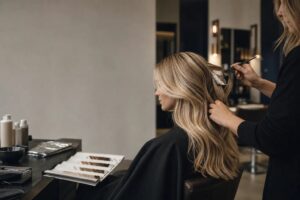
Hair color correction in Austin fixes color gone wrong: brassiness that resists every toner, dark box dye that blocks lightening, uneven bands left by a rushed highlight, or a DIY attempt that produced two different colors on the same head. Correction is not the same as a color refresh, and it rarely wraps up in a single appointment. According to Sara Carden Hair and Aveda Arts Austin, corrective color in the Austin market runs from roughly $200 for a minor toner adjustment to $1,200 or more for a multi-session dark-to-blonde transformation, and the timeline can stretch from one afternoon to six months depending on your starting point.
Understanding what you are actually dealing with, what it realistically costs, and what to look for in a stylist makes the difference between a correction that delivers and one that leaves your hair worse than before. At Harlow Beauty and Hair Salon on Burnet Road, every corrective color service begins with a thorough consultation because no two correction cases are the same, and that philosophy shapes everything below.
Key takeaways
- Correction vs. refresh: Color correction restructures underlying pigment or removes artificial color molecules; a toner or gloss alone is not a correction.
- Realistic timeline: Minor brassiness can resolve in one session; box-dye removal and dark-to-blonde transformations typically take two to five or more appointments over three to six months.
- Cost range: According to Sara Carden Hair and Aveda Arts Austin, expect $200 to $400 for minor fixes, $400 to $700 for moderate corrections, and $700 to $1,200 or more for major transformations in Austin.
- Verify credentials: An active Texas cosmetology license and a portfolio of at least 10 to 15 relevant before-and-after examples matter more than any “master colorist” title.
- Consultation first: Most reputable Austin salons require a thorough consultation before quoting corrective color; that is a sign of competence, not delay.
What exactly is hair color correction, and do you actually need it?
The difference between a color fix and a full correction
A color fix like a toner or gloss addresses surface tone. Full correction goes deeper: it restructures underlying pigment, removes artificial color molecules from the hair cortex, or re-lifts hair that was not processed evenly. The distinction matters because salons price and schedule them very differently. If you have a single brassy stripe after a highlight, a toner may be all you need. If you have dark box dye layered over old highlights with a visible demarcation line at the roots, you need a corrective plan that spans multiple appointments.
Common problems that qualify as color correction
The four most common cases are brassiness that will not respond to toner, box-dye removal, uneven or banded highlights, and dark-to-blonde transformations. Brassiness that persists after toning usually signals that the underlying warm pigment was never fully neutralized during the original service. Box dye is particularly stubborn because it deposits dense artificial molecules throughout the hair shaft, leaving behind orange mid-lengths or a muddy cast when a colorist attempts to lighten over it. Uneven highlights show up as bands where the lightener stopped mid-strand, or as a patchy, inconsistent result from overlapping applications. A dark-to-blonde transformation compounds all of these challenges because the hair must be lifted in controlled stages, and each stage exposes a different set of undertones that require careful management.
When a general colorist is not the right call
Corrective color demands a different skill set than a standard color appointment. Formulating for color removal, strand-testing for porosity and elasticity, managing bond integrity across multiple chemical steps, and sequencing a multi-session plan safely are all specialized competencies. A general colorist who performs corrections occasionally may not have enough relevant experience to handle a complex starting point confidently. The stakes are higher than with any standard color service: a rushed or under-informed correction can cause breakage, uneven lift, or unpredictable tones that cost significantly more time and money to address.
Why does hair color correction in Austin take more than one appointment?
What happens inside the hair during lightening and removal
Artificial pigment sits in the hair’s cortex, the inner layer responsible for strength and elasticity. Lightening and removal products break down those pigment molecules, but the hair’s condition determines how aggressively a colorist can work in a single session. A strand with high porosity from previous chemical services absorbs product unevenly and is more vulnerable to structural damage. Think of it this way: the hair is a sponge that has been squeezed many times before. Elasticity tells the colorist whether the hair can safely handle another round of chemistry; hair that stretches when wet and does not spring back needs time before the next appointment.
The real risk of rushing the process
Forcing a dark-to-blonde transformation into one appointment raises breakage risk significantly. When too much is attempted in a single visit, the result can be uneven lift, unpredictable tones, and structural damage that snaps hair. A credible colorist will tell you what is safely achievable in session one and be honest that the final result requires follow-up appointments. If a stylist promises a dramatic same-day result after a five-minute conversation, that is a red flag worth taking seriously before anything touches your hair.
Realistic timelines for the most common cases
Box-dye removal typically takes two to four appointments spaced four to eight weeks apart to allow the hair to recover between sessions. A dark-to-blonde transformation commonly requires three to five or more appointments over three to six months, with four to six weeks between lightening sessions. These are starting points, not guarantees: your hair’s condition, porosity, and chemical history can shift the numbers in either direction.
What does corrective color cost in Austin?
A realistic price range by severity
Corrective color pricing in Austin breaks into three practical tiers. According to Sara Carden Hair and Aveda Arts Austin, a minor correction such as a toner, gloss, or slight shade adjustment runs roughly $200 to $400.
Most Austin salons require a consultation before quoting corrective color, and that practice is a sign the salon is approaching the work seriously rather than guessing at a price. A quote that looks affordable at a glance can grow considerably once toner, bond repair, a blowout, and follow-up sessions are factored in.
What drives the final number up
Hair length, density, the number of previous color applications, and the degree of existing damage all push a quote higher. Product volume matters too, particularly when bond-building treatments are added to the lightener to reduce breakage risk during chemical processing. Ask specifically whether the estimate includes toner, color remover, bond repair, blowout, cut, and planned follow-up sessions. Understanding exactly what is and is not in the quote before you commit saves a lot of frustration later.
How to find a qualified corrective color specialist in Austin
Credentials and training worth verifying
Start with an active Texas cosmetology license, which you can verify through the Texas Department of Licensing and Regulation. From there, look for documented advanced color education through recognized academies such as Redken, Wella, Goldwell, L’Oréal Professionnel, or Schwarzkopf Professional. Ask what the training specifically covered: color theory, blonding, formulation, corrective techniques, or a combination. The title “master colorist” carries no universal standard, so a portfolio of at least 10 to 15 before-and-after correction cases similar to your starting point tells you far more than any job title will.
If you find yourself searching for corrective color specialists near me, those portfolio examples are the single most useful filter you have. A stylist who can show you documented, comparable corrections is worth far more than one who can only describe their experience.
What a serious consultation actually looks like
We take a consult-led approach at Harlow Beauty and Hair Salon, building every corrective plan around your hair’s actual condition rather than a fixed service menu. That means your colorist explains the specific corrective sequence they plan to use, why they are recommending it, and what the result will look like at the end of session one versus the end of the full process. If a stylist skips the assessment and promises a major transformation in a single visit, that is not a deal; it is a liability.
Questions to ask before you book
Bring these questions to any corrective color consultation so you can evaluate the stylist’s answer quality, not just their enthusiasm:
- Can you show me before-and-after examples of corrections similar to my starting color?
- What is safely achievable in the first session, and what will require follow-up appointments?
- Does your quote include toner, bond repair, blowout, and future sessions, or only the initial service?
- How will you assess whether my hair can safely handle the process?
- What would cause you to stop or adjust the plan mid-appointment?
A colorist who answers these questions specifically and honestly, including being willing to say “I would stop if,” is a colorist worth trusting with a complex correction. That kind of transparency is especially important in a color emergency; an Austin salon that encourages these questions upfront is one that takes the work seriously.
How to prepare your hair and care for it between sessions
What to do before your first appointment
Stop using box color or doing any home lightening as soon as you book your consultation. Many stylists recommend coming in with unwashed hair and avoiding silicone-heavy products for the two days before your appointment, since silicone buildup can affect how evenly color processes through the strand, follow your specific stylist’s pre-appointment guidance when you book. Bring photos of the problem and clear reference images of your desired result: a precise reference helps your colorist formulate accurately and sets shared expectations before the service begins. On particularly damaged or porous hair, your stylist may perform a strand test before the full service, which is standard practice and worth welcoming, not rushing past.
Caring for hair between correction sessions
Use a sulfate-free, color-safe shampoo and follow your stylist’s guidance on when to wash after each session. Follow the bond-building or protein treatment your stylist recommends, and limit heat styling between appointments, since heat stresses already-processed hair. The goal between sessions is to preserve your hair’s condition, not to accelerate the color result with at-home products your stylist did not recommend. At Harlow, we carry Kérastase and Innersense, both formulated specifically for color-treated and chemically processed hair, and we can point you toward the right products to support your hair between visits.
The bottom line on hair color correction in Austin
Color correction is a technical specialty that requires honest expectations from both sides of the chair. It takes multiple appointments, real expertise, and a stylist willing to tell you what is possible at each stage rather than what you want to hear today. The cost reflects time, product, and skill. Clients who choose based on price alone, without verifying corrective-specific experience, often end up spending more to fix the fix.
When you are ready to start the process, look for a salon that builds the corrective plan around your hair’s actual condition rather than a fixed service menu. At Harlow Beauty and Hair Salon on Burnet Road, that is exactly how we approach every correction: with a thorough consultation, close attention to your hair’s health at each stage, and honesty about what is safely achievable per session. Our team brings advanced color education and strong blonding and color expertise, all under one roof in North Austin.
Take our stylist-matching quiz to find the right colorist for your specific situation, then reach out to book a consultation. That conversation gives you a clear picture of what your correction involves, how long it will take, and what it will cost, so you can move forward with confidence, not guesswork.
Frequently Asked Questions
Will I have a consultation before you quote corrective color and why does it matter?
Yes, most reputable Austin salons require a thorough consultation before quoting corrective color, and we do the same because no two correction cases are the same. A consult-led approach lets us assess your hair’s condition, explain the corrective sequence we recommend, and avoid guessing at a price that can grow once products and follow-up sessions are added.
Does the quoted price usually include toner, bond repair, blowouts, and follow-up sessions?
Not always, so you should ask specifically what the estimate includes before you commit. We advise confirming whether toner, color remover, bond repair, blowout, cut, and planned follow-up appointments are part of the quote to avoid surprise costs later.
How long should I expect to wait between corrective color sessions?
Typical spacing is four to eight weeks for box-dye removal sessions and four to six weeks between lightening sessions during a dark-to-blonde transformation. Those timelines are starting points and can shift depending on your hair’s condition, porosity, and chemical history.
Should I stop using box color or home lightening before my consultation and first appointment?
Yes, stop using box color or doing any home lightening as soon as you book your consultation. We also recommend avoiding silicone-heavy products for two days before your appointment and following any specific pre-appointment guidance your stylist provides.