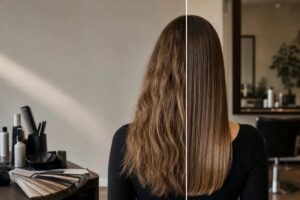

Texas humidity doesn’t take a season off. From the muggy stretch of spring through the thick air of late fall, Austin sits at an average relative humidity around 65, 71%, and for women with thick, coarse, or frizzy hair, that number is felt every single morning. You spend 20 minutes with a round brush and a blow dryer, step outside onto Burnet Road, and by the time you reach your car, your hair has already decided to do something else entirely. A keratin treatment for thick frizzy hair in Texas humidity can stop that morning frustration before it starts, but only if you choose the right formula for your specific hair type and lifestyle.
At Harlow Beauty and Hair Salon in North Austin, stylists commonly hear this frustration from new clients. Not a dislike of their natural hair. Not a request for a dramatic transformation. Just a desire to stop losing the daily battle against a climate that seems personally committed to undoing every styling effort before 9 a.m. Keratin smoothing treatments exist precisely for this problem, but they’re not all the same, and choosing the wrong one for your hair type means disappointing results that fade in six weeks instead of five months.
This article is a practical decision guide. By the time you finish reading, you’ll understand how keratin treatments work on thick, resistant hair, which treatment option fits your lifestyle and hair goals, what realistic results look like in a humid Texas climate, and what aftercare actually requires. No fluff, no vague promises.
Why Texas humidity hits thick and frizzy hair hardest
Frizz isn’t random. It’s a structural response that happens at the level of the hair cuticle, the outer layer of each strand that resembles overlapping shingles when viewed under a microscope. When the cuticle is raised or porous, it absorbs moisture from the surrounding air, which causes the hair shaft to swell unevenly. That uneven swelling is what creates the puffiness and flyaways that no amount of smoothing serum can fully contain in 70% humidity.
What humidity actually does to the hair cuticle
Hair porosity, not thickness alone, is what determines how reactive your hair is to humid air. Thick, coarse hair often comes with greater cuticle irregularity, and when porosity is high, moisture absorption accelerates dramatically. In Austin, where humidity regularly climbs between 65, 71% across most of the year with May peaking near 71%, this cuticle absorption cycle is essentially nonstop. The hair swells, dries slightly, swells again. Standard anti-frizz products create a temporary surface coating, but they don’t change the underlying cuticle structure, so results dissolve the moment real humidity hits.
Why heat styling alone doesn’t solve the problem
A flat iron smooths the cuticle temporarily by using heat to press it flat. The problem is that it doesn’t seal the cuticle or fill the gaps that allow moisture absorption. Step outside into humid air, the cuticle lifts again, humidity rushes in, and the frizz is back. This is the gap that a keratin treatment for thick frizzy hair in Texas humidity is specifically designed to close. Instead of fighting moisture every morning, the treatment changes how the hair responds to humidity structurally, at the fiber level, so the daily battle stops being a battle.
How a keratin treatment for thick frizzy hair in Texas humidity works
A keratin treatment infuses a protein solution directly into the hair shaft, filling cuticle gaps and coating the outer layer of each strand. Heat from a flat iron then seals that coating in place. The result is a smoother, denser surface that is far less reactive to moisture in the air. For thick, coarse hair, this sealing effect is more impactful than on fine hair because there’s more surface area to correct and more cuticle irregularity to fill.
What the treatment does to the hair structure
Think of the keratin coating as a moisture barrier built into the hair rather than layered on top of it. Because the protein solution fills existing cuticle gaps rather than just sitting on the surface, it holds up considerably better against humidity than any product applied after styling. High-porosity thick hair absorbs the initial treatment readily, which means frizz reduction is often dramatic after the first service. The trade-off with high porosity is that the treatment can also fade faster without proper aftercare, which makes the post-service routine more important, not less.
Why professional application matters for resistant hair
Thick, coarse, or resistant hair typically requires longer processing time, more precise heat application, and a higher-strength formula than fine hair. An under-processed keratin treatment on thick hair leaves results patchy or fading far sooner than expected. The skill level and experience of the stylist directly determines the outcome, especially for hair types that don’t respond predictably to standard application protocols. Stylist experience isn’t a bonus here, it’s the deciding factor between a treatment that lasts five months and one that disappoints at week six.
Keratin vs Brazilian Blowout vs formaldehyde-free: what to know before you choose
These three options are often grouped together in conversation, but they work differently and suit different goals. The key distinctions come down to durability, formula strength, and chemical exposure, understanding those trade-offs before you book saves you from choosing a salon keratin treatment in Texas that doesn’t fit your hair type or lifestyle.
Brazilian Blowout: frizz control with more natural movement
Brazilian Blowout is one of the most popular anti-humidity hair treatments and typically lasts about 10, 12 weeks. It seals the cuticle and significantly reduces frizz while allowing the hair to retain more of its natural texture and wave pattern. For thick hair that isn’t extremely coarse or tightly curly, it’s a strong option, particularly for clients who want smoother hair without losing all of their natural movement. The honest trade-off: in very high-humidity conditions, results can fade closer to the 8-week mark, especially with frequent washing.
Traditional keratin smoothing treatment: when longevity is the priority
A traditional keratin smoothing treatment typically lasts 3, 5 months, making it the longer-wearing option and the stronger performer on very thick, coarse, or curly hair in extreme humidity. The smoothing effect is more uniform, and the moisture barrier is more robust, which is why it holds up better through Austin’s persistent humid seasons. Some traditional keratin formulas contain formaldehyde-releasing agents, which is an important safety consideration worth discussing with your stylist before booking so you can weigh that factor against the performance benefit.
Formaldehyde-free smoothing treatments: the trade-offs worth knowing
Formaldehyde-free keratin alternatives, many of which use glyoxylic acid as the active smoothing agent, deliver meaningful frizz reduction and improved softness with lower fume exposure during application. In practice, formaldehyde-free formulas tend to deliver roughly 85, 90% of the smoothing and longevity of traditional keratin on coarse hair, meaningful, but not equal for the most resistant hair types. Durability is typically shorter, often 8, 12 weeks in humid climates, and the smoothing is less aggressive. They’re a solid fit for clients whose primary goal is manageability and softness rather than maximum straightening or the longest possible result.
What realistic results look like on thick hair in Texas
One of the most common sources of dissatisfaction with keratin treatments is misaligned expectations. Clients with thick, coarse hair sometimes compare their results to before-and-after photos of fine or naturally wavy hair, which creates an unfair benchmark. Understanding what the treatment actually delivers for your specific hair type prevents disappointment and helps you evaluate whether the service worked as intended.
How long treatments typically last under daily Texas humidity
Traditional keratin runs 3, 5 months, Brazilian Blowout runs 10, 12 weeks, and formaldehyde-free treatments land around 8, 12 weeks. Texas-specific factors, including persistent humidity, frequent sweating, and swimming in chlorinated pools, push results toward the shorter end of those ranges. Washing frequency is one of the single most impactful variables: daily washing with any shampoo accelerates fading significantly faster than washing 2, 3 times per week with a sulfate-free formula. At a luxury salon in Austin, a professional keratin smoothing treatment for thick or coarse hair typically runs $375, $450 in 2026, making the keratin aftercare for frizzy hair a real investment worth protecting.
What “less frizzy” actually means for thick, coarse hair
Keratin treatments reduce frizz and increase smoothness substantially, but they don’t permanently change your curl pattern or produce bone-straight hair on their own. Clients with thick, wavy, or coarse hair typically experience a dramatically smoother version of their natural texture: less puffiness, faster blowout time, hair that doesn’t expand the moment they step outside, and easier styling overall. For many North Austin clients, that outcome means the difference between a 20-minute morning routine and a 45-minute one.
The aftercare that keeps your results going in humid weather
A keratin treatment is a one-time service you then maintain for months, and how you handle the first few days determines how much of that lifespan you actually get. Skipping steps during the critical early period is the most common reason clients don’t see full longevity from their results.
The first 72 hours after your treatment
The 48, 72 hours immediately following the service is when the keratin bonds are still setting. Avoid tight styling, minimize handling, and keep hair dry, that means no washing, no tight clips, and no exposure to significant humidity or sweat during this window. If hair gets damp from rain or a workout, dry it immediately on low heat. This period is when results are most vulnerable to being compromised, and the habits formed here directly affect how long the treatment performs before it needs to be refreshed.
The at-home routine that protects results long-term
Sulfate-free shampoo and conditioner are non-negotiable. Sulfates strip the keratin coating faster than any other factor in your at-home routine. Sodium chloride-free products are also recommended, since salt-heavy formulas accelerate fading in the same way. Beyond cleansing, a practical humidity-proof hair treatment maintenance routine for Texas looks like this:
- Wash 2, 3 times per week rather than daily, using a sulfate-free and sodium chloride-free formula
- Apply an anti-humidity serum to mid-lengths and ends before leaving the house on humid days
- Use a weekly deep-conditioning mask to support moisture balance without overwashing
- Sleep on a silk or satin pillowcase to minimize friction and preserve the smooth coating overnight
- Blow-dry fully after washing; leaving hair even slightly damp makes humidity-induced frizz worse
Avoid clarifying shampoos, sea salt sprays, and anything labeled “strengthening” that may contain high protein concentrations, since these can make keratin-treated hair feel stiff or brittle over time. The goal is maintaining the moisture balance the treatment created, not overloading the hair with additional actives.
Choosing the right keratin treatment salon in North Austin
Not every salon that offers a keratin or smoothing service has meaningful experience applying it to thick, resistant hair. The application protocol for coarse hair is meaningfully different from fine hair, and a stylist without that specific experience may under-process the treatment or choose the wrong formula strength, leaving results that underperform from the start.
What to ask before you book
Ask any potential salon about their experience with thick, coarse, or resistant hair types specifically. Ask which product line they use, whether they offer a formaldehyde-free option, and whether they conduct a consultation before the service to assess your hair’s porosity, texture, and condition before selecting a formula. These questions separate keratin specialists from salons that offer it as an add-on. A real specialist will welcome the conversation; a salon that can’t answer these questions confidently is a signal to keep looking.
Why Harlow’s approach works for Texas hair
Harlow Beauty and Hair Salon on Burnet Road in North Austin was built around a consult-first, detail-obsessed approach that makes a real difference for clients dealing with humidity-prone hair. Harlow’s stylists work with professional-grade lines including Kérastase and assess each client’s hair texture, porosity, and lifestyle before selecting a smoothing formula, the kind of specificity that separates a result lasting several months from one that fades in six weeks. For new clients who aren’t sure which treatment fits their hair, Harlow offers a stylist-matching consultation to pair you with the right specialist before you ever book a seat.
Making the right call for your hair
Choosing a keratin treatment for thick frizzy hair in Texas humidity isn’t a one-size decision. The right choice depends on how thick and coarse your hair is, how long you want results to last, your tolerance for a stronger chemical formula, and how committed you are to aftercare. Brazilian Blowout suits clients who want natural movement and a shorter commitment. Traditional keratin is the better fit for maximum longevity and smoothing power on very resistant hair. Formaldehyde-free alternatives offer a gentler path with softer results and a shorter lifespan.
If you’re in North Austin and ready to stop losing the morning battle against Texas humidity, the right keratin treatment for thick frizzy hair in Texas humidity starts with a proper consultation. Reach out to Harlow’s team, discuss your hair goals with a specialist, and find out exactly which salon keratin treatment in Texas matches your hair. The goal isn’t just smoother hair for a few weeks, it’s a routine that actually holds up to the climate you live in every day. Book a consultation with Harlow Beauty and Hair Salon today.