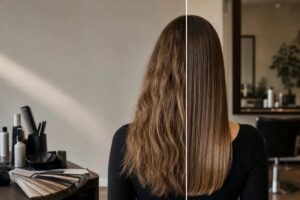
Austin summers are beautiful and relentless. The moment you step outside after a careful blowout, the humidity hits, the cuticle lifts, and within an hour your hair has made its own plans. For many women living here, this isn’t a minor inconvenience, it’s a daily reality that shapes how they think about hair care, styling time, and which products actually earn their shelf space. If you’re searching for a keratin treatment Austin TX clients actually rely on, this guide covers everything you need: how these treatments work, which type fits your goal, what Austin salons charge in 2026, and how to protect your results long after the appointment ends.
At Harlow Beauty and Hair Salon on Burnet Road in North Austin’s Allandale neighborhood, keratin smoothing is treated the same way the team treats every color formula: with precision, product knowledge, and a real conversation first. For color-treated clients especially, the formula selection matters as much as the service itself. By the time you finish reading, you’ll know which treatment type matches your hair goals, what to ask before you book, and how to protect your results once you leave the chair.
How keratin treatments work and why Austin’s climate makes them so relevant
Your hair is already made of keratin protein. Frizz isn’t a product of bad hair, it’s a mechanical response to humidity. When the outer cuticle layer lifts in the presence of moisture, strands absorb water vapor from the air, swell from the inside, and lose their smooth alignment. The result is the puff, halo, or wave-turned-frizz pattern that most Austin women know well. A keratin treatment works by filling and reinforcing the cuticle with a protein-based formula, then using heat to seal that coating flat. The hair becomes less porous, and less porous hair absorbs less moisture from the air.
Austin’s climate creates a specific kind of hair stress that goes beyond just “it’s humid outside.” The city’s summer heat index regularly pushes into uncomfortable territory, and the constant cycle between air-conditioned interiors and outdoor heat creates repeated moisture swings throughout the day. Every transition is a small cuticle event. Over time, that repeated expansion and contraction raises porosity, which makes the frizz problem progressively worse. Keratin smoothing interrupts that cycle by creating a barrier moisture can’t penetrate as easily.
Realistic expectations matter here. Most professional keratin and smoothing treatments last between three and five months, depending on the formula used, your hair’s natural texture, and how well you maintain the results. Thicker, coarser curl patterns tend to see results closer to the three-month end of that range. The good news is that results don’t reverse overnight. As the treatment fades, it softens gradually back toward the hair’s natural state rather than snapping back all at once after a certain date.
Types of keratin smoothing treatments and which one fits your goal
Not every smoothing service produces the same result, and choosing the wrong category for your hair goal is one of the most common reasons clients leave disappointed. The three main types available at keratin studios in Austin are Brazilian blowout-style treatments, formaldehyde-free keratin options, and curl-preserving smoothing services. Each one serves a different purpose.
Brazilian blowout-style treatments deliver the most dramatic frizz reduction and produce a glossy, polished finish. They’re the right choice when the goal is significant texture softening and a very sleek final look. These treatments use stronger formulas and higher heat during processing, which is what produces the most visible transformation. Austin salons list these starting around $168 on deal platforms and up to $400 or more at premium studios, reflecting both formula strength and stylist experience level.
Formaldehyde-free keratin options, including products like Cezanne and Keratin Complex Frizz-Fighting treatments, are designed to smooth and reduce frizz without altering curl pattern as aggressively. They’re a strong fit for clients who want to keep their natural texture looser, or who have concerns about chemical exposure. The important nuance: “formaldehyde-free” on a label requires scrutiny. Certain ingredients, when heated during processing, can still release formaldehyde gas. That distinction gets its own section below.
For curly hair clients who want frizz reduction without losing their curl definition, there are smoothing services designed specifically to tame the frizz halo while leaving curl structure intact. Curl-focused studios in Austin position these services around hair health and controlled smoothing rather than straightening. Before you book anything, get clear on your actual goal: full sleekness, smoothed waves, or frizz-free curls. The answer determines which treatment category you need.
Safety: the questions worth asking before you sit down
The “formaldehyde-free” label has a meaningful limitation. Some smoothing product formulas use ingredients that don’t contain formaldehyde in their resting state but release formaldehyde gas when heated during the flat-iron step of the service. This means the label alone doesn’t tell you what’s actually in the air during your appointment. The better question to ask a salon isn’t “is this formaldehyde-free?” but rather “does this product release formaldehyde under heat?”
When reviewing ingredient lists, here are the specific names to look for:
- Methylene glycol, formalin, and formaldehyde monohydrate (all formaldehyde forms)
- Glyoxal and DMDM hydantoin (formaldehyde-releasing compounds)
- Quaternium-15, imidazolidinyl urea, and diazolidinyl urea (common preservatives that release formaldehyde)
- Timonacic acid (releases formaldehyde specifically during the heating process)
- Paraformaldehyde and polyoxymethylene (formaldehyde-related polymer forms)
That list is worth saving to your phone before any smoothing consultation. Some clients should also have a direct conversation with their stylist before booking any treatment at all. If you’re pregnant, have very fine or significantly damaged hair, or have recently had a chemical relaxer, discussing those details upfront protects both your hair and your results. This isn’t alarmism, it’s the kind of honest guidance a good salon provides before taking your money, not after.
What your keratin appointment actually looks like
A standard keratin smoothing service runs between two and four hours, depending on your hair length and thickness. The process starts with a thorough clarifying shampoo to remove buildup and open the cuticle so the treatment can penetrate evenly. After a towel dry, your stylist applies the smoothing formula section by section, working it through from root to tip. A processing time follows, then the flat-iron pass that seals the formula and locks the cuticle smooth. The appointment finishes with a blow-dry showing you the final result.
Wear comfortable clothes you don’t mind getting product on, and communicate your hair history clearly before the service starts. Previous chemical services, current color work, and any scalp sensitivities are all relevant information. For color-treated clients, a brief consultation to confirm formula compatibility is worth the extra few minutes. At Harlow, the consult-led approach means no one applies a one-size formula without discussing your existing color and hair health first. That detail protects both your smoothing results and the integrity of your balayage or blonding work.
The first 72 hours after you leave the salon are the most critical part of the entire process. The formula is still bonding and setting during this window. Keep hair completely dry, leave it loose and unbound, and avoid anything that compresses or creases the hair: ponytail elastics, bobby pins, hats, headbands, and even tucking hair behind your ears. Any crease or fold made during this period can become permanent in the treatment. After 72 hours, you can wash and style normally within your new aftercare routine.
Aftercare habits that protect your investment
The single most important product swap after a keratin treatment is moving to a sulfate-free, sodium-chloride-free shampoo. Sulfates are highly effective cleansers, which is exactly the problem: they strip the smoothing treatment faster than any other factor. Check the label of any shampoo you’re considering, and look for both sodium lauryl sulfate and sodium laureth sulfate to avoid. Professional lines like Kérastase, which Harlow carries and uses in their services, formulate specifically for treated hair and won’t compromise your results between appointments.
Austin’s active outdoor lifestyle works against keratin longevity in specific ways. Chlorine from pools, salt water if you make it to the coast, and sweat from outdoor workouts all accelerate fading. Frequent washing compounds the effect. A few practical adjustments make a real difference: rinse hair immediately after swimming so chlorine or salt don’t have time to penetrate, apply a light leave-in protectant before sun and sweat exposure, and aim to wash no more than two to three times per week. These habits aren’t dramatic, but they consistently extend a three-month result toward four or five months.
Smart styling habits also matter. Use a light heat protectant before blow-drying, keep manipulation minimal during the first few weeks while the treatment is fully set, and keep your routine simple. The whole point of a smoothing treatment is reducing daily effort, and layering complex styling routines on top of it undermines that goal. Let the treatment do its job.
Keratin treatment Austin, Texas: prices and what to look for in 2026
Austin’s keratin treatment market in 2026 runs a wide price range, and understanding what drives that range helps you make a smarter booking decision. The 2026 market median for a standard smoothing treatment in Austin sits around $250, based on a survey of 19 salons and 28 service listings. Express or mini treatments often land under $180. Full keratin services with experienced stylists typically run $300 to $450 for longer or thicker hair. Deal platforms like Groupon list options at $168 to $225 after discount, which can be reasonable, but those bookings warrant specific questions about formula quality and stylist experience before you commit.
Fresha-listed Austin salons start keratin services at $299 to $400 for documented keratin work, and the upper end of the market reaches $750 at certain premium studios. Prices as low as $12 to $20 on aggregator searches typically reflect express blowout services rather than true keratin smoothing treatments. The price range on any platform tells you less than asking directly about the specific product line and the stylist’s experience with your hair type.
Harlow Beauty and Hair Salon serves North Austin clients as a color-and-keratin integration specialist, not a salon that treats smoothing as an afterthought. Their stylists, who include a Kérastase Ambassador and Eufora Educator, select smoothing formulas that work with existing color rather than dulling or stripping it. For clients with balayage, dimensional blonding, or brunette color work, that distinction matters significantly. The consult-led approach means you’re discussing your hair goals, color history, and lifestyle before any product touches your hair.
Before booking at any Austin salon, whether you found it through a “keratin treatment near me” search or a personal referral, ask these questions directly:
- What specific product line do you use for your keratin service?
- Does this product release formaldehyde under heat?
- Do you have experience working with color-treated or highlighted hair?
- What does your aftercare protocol look like, and what products do you recommend?
- Can you show examples of your smoothing results on hair similar to mine?
A salon that can answer those questions clearly and specifically is worth the appointment. One that pivots to vague reassurances deserves a follow-up call to a different salon.
Bringing it all together before you book
A keratin smoothing treatment is one of the more practical hair investments available to Austin women, given what the climate actually puts hair through. The key is matching the treatment type to your real goal, whether that’s maximum sleekness, smoothed waves with movement, or frizz reduction that keeps your curls intact. Each of those goals points to a different formula, and choosing the right one determines whether you leave thrilled or only partially satisfied.
The safety questions are worth asking at every salon, not because smoothing treatments are inherently dangerous, but because informed clients get better results. Knowing the ingredient names, understanding what “formaldehyde-free” actually means in practice, and communicating your hair history clearly all set you up for a service that works with your hair rather than around it. The aftercare commitment is real but manageable: sulfate-free products, less frequent washing, and protecting hair from chlorine and sweat go a long way toward keeping your results into month four or five.
For a keratin treatment Austin TX residents with color-treated hair can trust, reach out to the team at Harlow Beauty and Hair Salon on Burnet Road to schedule a consultation. The smoothing formula you receive is chosen to complement your existing color work, not work around it, and the result you leave with reflects the conversation you had before the service started. That’s the kind of appointment worth booking.