You leave the salon on a Friday, and the color is everything you wanted: soft, bright, dimensional, effortless. Then, within a few weeks to two months depending on your growth rate and technique, the roots become visible, the contrast feels harsh, and what looked sun-kissed at the salon now just looks dyed. Sound familiar? The problem usually isn’t the technique itself. It’s that the wrong technique was chosen for the wrong hair, or the shade selection pulled the whole thing off-course before it had a chance. Figuring out the best hair color technique for natural looking results means asking the same question Harlow Beauty and Hair Salon’s colorists start with at every consultation before a single formula is mixed: what will this color look like on day one, and what will it look like on day 60?
Getting a truly natural result from color isn’t about going subtle or staying safe. It’s about understanding which techniques deliver soft, believable results at application, which ones grow out without a harsh line of demarcation, and which shade rules keep everything looking like it belongs on your head. Once you understand those three pieces, you can walk into any salon appointment and ask for exactly what you need.
What “natural-looking” actually means in hair color
Most people use “natural” to mean “not too much.” But natural-looking color is really defined by two separate moments: how the color reads the day it’s applied, and how it behaves as it grows out. A technique can nail one of those moments and completely miss the other. Understanding both is what separates a great colorist from one who delivers results that fade fast.
Two moments that define natural results: day one and week eight
On day one, natural-looking color reads as dimensional, with variation in tone that mimics the way sunlight hits hair. There are no uniform stripes, no obvious root-to-tip saturation, and no single flat shade coating every strand. At week eight, natural color means the grow-out doesn’t create a visible band. The root transitions softly into the lightened mid-lengths and ends, so the hair looks intentional rather than neglected. A technique that creates a harsh line of demarcation at six weeks will always feel like more upkeep than it actually is.
Why freehand placement reads differently than foil
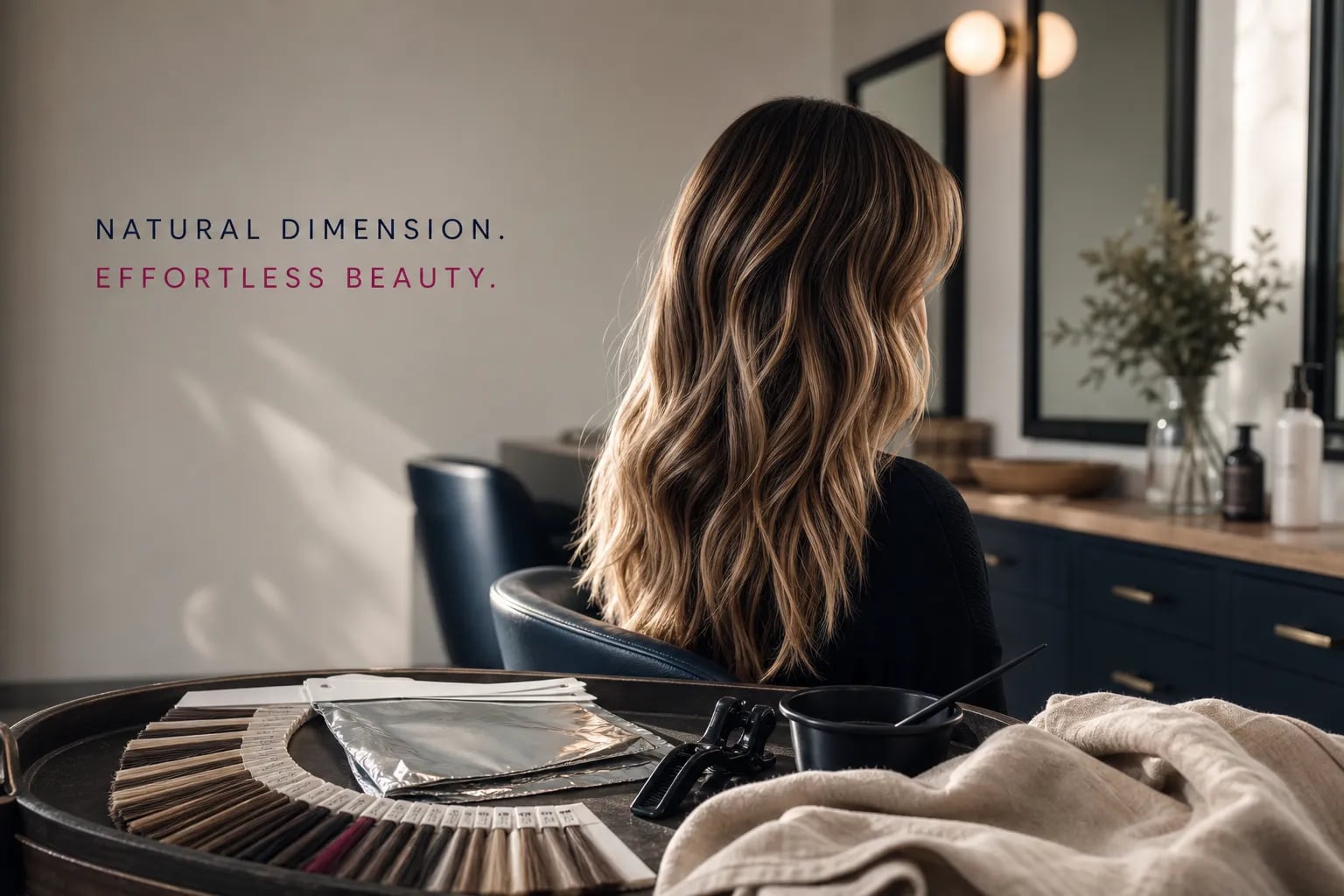
Foil highlights saturate hair from a point close to the root all the way through to the ends. That creates uniform brightness, which is exactly the quality that reads as “dyed” as the hair grows in. Freehand techniques, by contrast, apply color to the surface of sections from mid-length downward, intentionally leaving the root area darker. The result mimics what actually happens to hair that spends time in the sun: lighter at the ends, darker at the root. That mirroring of a natural process is why freehand placement tends to look believable at both stages of the grow-out cycle.
Balayage: the best hair color technique for natural looking results in most cases
Balayage has dominated the conversation around natural color for good reason. Its freehand, painted application creates dimension that looks earned rather than constructed, and its grow-out is genuinely forgiving in a way few other techniques match. The technique isn’t perfect for every situation, but understanding where it excels helps you decide whether it belongs in your next appointment.
How it mimics the way sunlight actually hits hair
Balayage is applied freehand from mid-length to ends, leaving the root area darker and untouched. That deliberate darkness at the root is the key to its believability: it mirrors what natural sun exposure actually does, since sunlight hits the surface of the hair rather than the scalp. When applied to wavy or curly hair, a skilled colorist follows the curl pattern, placing lighter pieces along the outer curves and edges where light would naturally catch, rather than saturating flat sections.
The grow-out advantage that sets balayage apart
Because the root is typically not lightened during a balayage service, there’s no sharp contrast line to grow out. (Some balayage services do include face-framing or root-blending variations that bring color closer to the root, which can affect grow-out behavior.) As new hair comes in, it transitions seamlessly into the painted mid-lengths, making balayage one of the most genuinely low-maintenance hair color options available. Clients with darker or brunette bases benefit most from this quality, since the contrast between natural root color and lightened ends is the most visible indicator of regrowth in darker hair.
Which textures and base colors respond best
Balayage performs best on brunette-to-medium-brown bases and on wavy, curly, or textured hair. The movement in those textures creates natural variation in how light hits the hair, which makes freehand placement look completely organic. Fine, straight hair can work beautifully with balayage too, but it requires a lighter hand. Chunky sections read as stripes on flat, straight hair, so the placement needs to be more precise and the contrast kept lower.
Lived-in highlights and foilyage: more brightness, still believable
Not every client wants the restraint that balayage requires. Some hair needs more lift, and some clients want a visibly brighter result without crossing into high-maintenance territory. Lived-in highlights and foilyage solve both of those problems while preserving enough softness to still look realistic.
What separates lived-in highlights from traditional foil highlights
Traditional foil highlights place uniform brightness from root to tip, often in consistent sections, which creates the stripe-like pattern that reads as clearly “done.” Lived-in highlights use a more deliberate placement strategy: fewer pieces, softer placement, lower overall contrast. The goal is dimension that looks like it accumulated over time rather than in a single appointment. The result is brighter than balayage but softer than a full foil service, landing in a range that most people read as naturally sun-kissed.
When foilyage outperforms straight balayage
Foilyage combines balayage-style placement with the heat environment of a foil. Because foils trap heat, the lightener processes faster and more aggressively than open-air balayage. For very dark or resistant hair that balayage can’t lift meaningfully in one session, foilyage achieves noticeably more brightness while preserving the soft, blended placement that makes the result look natural. It’s the right call when a client wants visible lightness but balayage alone would leave the hair looking unchanged.
Grow-out behavior for lived-in color
Lived-in highlights grow out more softly than traditional foils, but not as seamlessly as balayage. At around eight weeks, there’s usually a visible root but without the sharp demarcation line that full foils create. Most clients find they can extend appointments to every three to four months comfortably. At the next visit, asking the colorist to refresh the root area with a root-smudge or shadow-root application extends the grow-out window further and keeps the result looking intentional.
Dimensional color and babylights: the subtle techniques most people overlook
Not every client wants transformation. Some want hair that looks better than it does now but in a way so refined that no one can pinpoint exactly what changed. Dimensional color and babylights are built for that goal, and they’re often underutilized because they don’t photograph dramatically or trend the same way balayage does.
What dimensional color actually does (and why it’s not just highlights)
Dimensional brunette color layers two to three close tones through brown hair: a rich anchor at the root, a slightly lighter mid-length, and sometimes a deeper lowlight piece for contrast. The difference between shades is intentionally small, usually two to three levels at most, so the result looks like natural variation rather than applied color. The root-smudge technique works hand-in-hand with dimensional color as a finishing step, softening any visible demarcation and extending the time between appointments. For brunettes who want richness and movement without going lighter, dimensional color is often the most satisfying result.
Babylights: an exceptionally subtle highlight option
Babylights use extremely fine sections to place very thin, delicate highlights throughout the hair. The resulting brightness is barely there, a soft glow rather than a visible shift, which is exactly why it reads as naturally sun-kissed rather than colored. The best candidates for babylights are clients with fine to medium hair, blonde to light-brown bases, and a goal of the lightest possible tonal shift. It’s a time-consuming service because the sections are so small, but the result is one of the most undetectable brightening techniques available, with color blending and toning that disappears seamlessly into the base.
How to know when subtle is enough and when it isn’t
A quick self-check before booking helps avoid disappointment: look at your reference photos honestly. If the hair you’re pointing to has clear, visible brightness and obvious contrast between root and mid-length, that result wasn’t created by babylights or dimensional color. Foilyage or lived-in highlights are what deliver that kind of shift. Choosing a subtle technique and expecting a high-contrast result leads to disappointment on both sides of the chair.
Shade selection rules that make color look like it belongs on you
Even the most precisely executed technique fails if the shade selection is off. Color that reads as artificial often isn’t a placement problem. It’s an undertone mismatch or a level jump that the eye immediately catches, even if the person looking can’t name exactly why the color feels wrong.
The 1, 2 level rule and how undertones seal the deal
Staying within one to two levels of the natural base color is one of the most reliable rules for achieving a natural finish, moving further creates a contrast the eye registers as “dyed,” especially at the regrowth line. Undertone alignment is what completes the illusion: warm skin tones carry golden, honey, and caramel shades naturally, while cool skin tones wear ash and beige tones more seamlessly. Mismatching undertones is what makes color look artificial even when the level is correct. A formula that’s two levels lighter than the base will look natural with the right undertone and jarring with the wrong one. This principle of shade selection for natural tones is central to every formula decision at Harlow.
How skin tone guides the colorist’s final formula decision
Generic shade charts fail clients because they ignore the interaction between hair color and skin tone. A level-seven warm blonde reads completely differently on olive skin than it does on fair, cool-toned skin. On olive skin, that warmth creates harmony; on cool, fair skin, it can pull brassy or orange in a way that reads as clearly processed. A colorist who factors in your skin’s undertone before finalizing a formula is what separates a result that looks grown-in from one that looks like an obvious dye job. This is the practical reason why a thorough consultation, not just a shade swatch, is the starting point for any natural-looking color service.
Why the right colorist matters as much as the right technique
Technique knowledge is a tool. Shade theory is a tool. The reason some color looks genuinely natural and some doesn’t often comes down to what happened in the twenty minutes before the formula was mixed. A consultation that takes lifestyle, hair history, skin tone, and realistic maintenance schedule into account produces a different result than one that skips straight to the formula.
The consult-first approach that changes everything
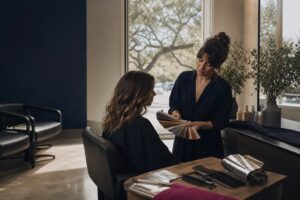
At Harlow Beauty and Hair Salon, no formula is mixed before a real conversation about where the client is starting, where they want to be, and how often they can realistically come back in. That conversation shapes which technique is selected, where the color is placed on each individual section, and how many levels the formula moves. Custom placement, not just technique choice, is what creates results that look grown-in and effortless rather than applied. The colorists at Harlow bring that same level of detail to brunette work and extensions as they do to blonding, which means the approach scales across hair types and goals rather than defaulting to a one-size formula.
What to ask for at your next salon appointment
Walk into your next color appointment with three specific questions ready, and expect real answers to all three. Ask which technique best matches your grow-out preference, because if you want the longest time between appointments, that answer should inform the method before anything else. Ask how many levels the formula will move from your natural base, since anything beyond two levels deserves a conversation about how the grow-out will look at the six-week mark. And ask how the shade selection accounts for your skin tone: a colorist who can answer that with specifics, not generalities, is one who will deliver a result that looks like it belongs on you.
Finding the best hair color technique for natural looking results that fits your hair and your life
There’s no single answer that works for everyone. Balayage delivers the most seamless grow-out and suits brunette to medium-brown bases especially well. Lived-in highlights and foilyage offer more visible brightness with reasonable blending, making them the right call for dark or resistant hair that needs more lift. Dimensional color and babylights create the most subtle, undetectable shifts for clients who want refinement over transformation. Each of those techniques succeeds or fails based on the shade selection that underlies it: undertone alignment and level proximity are what determine whether the result reads as natural or artificial.
Choosing the best hair color technique for natural looking results depends on your base color, texture, and maintenance goals, and the colorist who applies that knowledge thoughtfully, with a real understanding of your hair, your skin, and your life, is what makes the difference between color that looks beautiful for three weeks and effortless for three months. For clients who want to narrow it down before booking, Harlow’s stylist-matching process pairs you with the right colorist from the start. Reach out to the Harlow team and start the conversation before your next color appointment, not after.