If you’ve ever wondered what is the difference between balayage and highlights for someone who wants low maintenance color, you’re not alone, and the answer isn’t as simple as picking whichever one is trending. Picture this: you leave the salon every six weeks with the brightest, most beautiful highlights you’ve ever seen. By week three, the roots are already doing their thing. By week five, you’re wearing your hair up to buy yourself a few more days. You love the color. You hate the schedule. Sound familiar?
This is a conversation we have regularly at our salon in North Austin. New clients come in asking about balayage versus highlights, and the first question we always ask back is: how long do you actually want to go between visits? That single question changes everything, because the honest answer determines which technique is right for you, not which one is trending.
By the end of this article, you’ll have a clear picture of how these two techniques differ in grow-out pattern, annual cost, damage level, and lifestyle fit. You’ll also walk away with a short checklist of questions to bring to your next consultation so you stop guessing and start getting results that actually work for your schedule.
What is the difference between balayage and highlights for low-maintenance color
The single biggest difference between balayage and foil highlights isn’t how they look on day one, it’s where on the hair strand the color starts. That starting point drives your grow-out pattern, your maintenance cadence, and how much cumulative processing your hair accumulates over time. Understanding this distinction is the key to choosing the technique that genuinely fits your life.
How balayage is applied and why the grow-out is softer
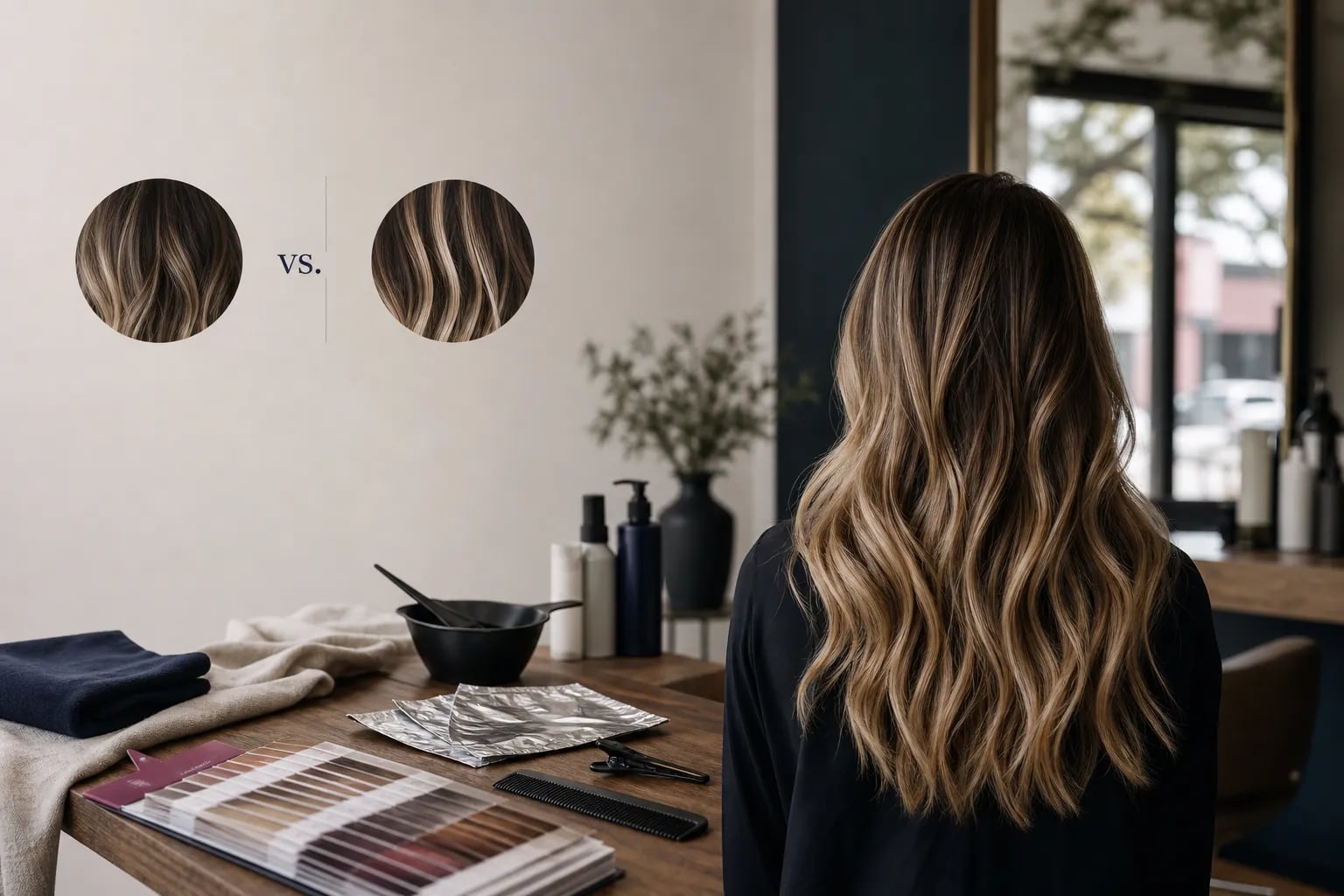
Balayage is a freehand hair painting technique. Your colorist sweeps lightener directly onto the surface of the hair, typically starting mid-shaft or lower, rather than from the root. Because no lightener touches the root area, there’s no hard line where your natural color ends and your highlighted color begins. As hair grows, the transition stays gradual and intentional rather than stark. This is the mechanical reason balayage grows out so forgivingly.
Two finishing techniques amplify this effect even further. A root melt blends a slightly deeper shade from the root down into the lighter lengths, creating a seamless gradient. A root shadow works similarly, adding depth at the scalp so any new growth looks like part of the design rather than a maintenance problem. Both techniques push the timeline between visits out considerably.
How foil highlights create that brighter, more structured look
Foil highlights work differently from the ground up. Your colorist sections off strands and applies lightener from the root all the way to the tip, then wraps each section in foil. The enclosed environment allows for more even, controlled lifting across the entire strand, which is why highlights produce a brighter, more uniform result. The tradeoff is structural: because color starts at the root, any new growth creates a visible line between your natural base and the lightened hair relatively quickly.
Babylights are worth mentioning here as a softer variation. They use extremely fine foil sections, so the lightening is more delicate and the regrowth line is less defined than with traditional thick-section highlights. They won’t give you the same grow-out forgiveness as balayage, but they land closer to the middle of the maintenance spectrum than standard foils do.
Root melts, babylights, and the techniques that fall in between
Partial highlights, glossing treatments, and babylights aren’t competitors to balayage or highlights; they’re modifications that adjust where any technique lands on the maintenance scale. A gloss refreshes tone and adds shine without major lightening. Partial highlights focus color on the top and front sections rather than the whole head, reducing how much hair is processed and how quickly regrowth becomes visible. Think of these as tools your colorist uses to tune the technique to your specific goals and schedule, not as entirely separate categories.
The grow-out test: which technique disappears more gracefully
Close your eyes and imagine your hair at week ten, week fourteen, week eighteen after your last appointment. What does it look like? That mental image is the most useful filter for choosing between these two techniques, because low-maintenance color isn’t about the first two weeks. It’s about the next four months.
Why balayage can go 3 to 6 months without a touch-up feeling necessary
Most balayage clients come in for a refresh every 8 to 12 weeks on the shorter end, but going 3 to 6 months before a full redo feels necessary is genuinely common. The lived-in color quality is the point for clients seeking a low-maintenance look. The grown-out result is designed to appear intentional, like natural sun-kissed dimension rather than neglected roots. When the technique is executed well and a root melt is included, even a five-month-old balayage can look like it was done last month.
Why foil highlights start showing regrowth around 6 to 8 weeks
Traditional foil highlights, because they’re applied root to tip, create a visible boundary between new growth and lightened hair at roughly the 6 to 8 week mark. The higher the contrast between your natural base and the lightened shade, the sooner that line becomes noticeable. Going from dark brown to bright blonde will show roots faster than going from medium brunette to soft honey. This isn’t a failure of the technique; it’s simply the physics of where the color starts.
How root melts and shadow roots buy you more time
If you love the brightness of highlights but hate the six-week clock, adding a root melt to your service is the most practical solution available. By blending a slightly deeper shade from the scalp down into the lightened lengths, the colorist removes the hard demarcation line that makes regrowth so obvious. The result is a highlight service that behaves more like balayage in terms of grow-out forgiveness, without sacrificing the uniform brightness that makes highlights appealing in the first place.
What you’ll actually spend: per visit, per year, and in the chair
The per-visit price of highlights often looks more affordable than balayage. Once you run the annual math, the comparison shifts.
Breaking down the appointment costs in 2026
Balayage at a mid-to-premium U.S. salon typically runs $150 to $350 or more per session, with appointments ranging from 2.5 to 5 hours depending on complexity. Full foil highlights generally come in at $120 to $250 per session and take 1.5 to 3 hours. In premium markets, both ranges sit toward the higher end. Your time in the chair is as real a cost as your card payment, especially if you’re scheduling during the workweek.
The annual math for balayage vs. highlights low-maintenance color
Here’s where the comparison shifts. If highlights require a visit every 6 to 8 weeks, you’re looking at roughly 6 to 8 appointments per year. Balayage at a 3 to 4 month interval means 3 to 4 appointments annually. At mid-to-premium salon pricing, full foil highlights can run $1,000 to $1,400 or more per year once you factor in toner and glossing add-ons. Balayage, despite the higher per-visit price, often lands closer to $600 to $900 annually. The math consistently favors balayage for clients who want to minimize time and money over a full year.
Which hair type and base color gets the best result
The best technique for low-maintenance color isn’t determined by what’s popular on social media. It’s determined by where your hair is starting and where you want it to go.
When balayage makes more sense for your hair
Balayage performs best on medium to long hair with wavy or curly texture. The hand-painted pieces follow the natural movement of the hair, so the dimension looks organic rather than applied. It also works beautifully on brunette and darker bases, where a soft grow-out blends naturally into the natural root color without a jarring contrast. Fine hair can benefit from balayage too, since subtle placement creates the appearance of dimension and movement without visible regrowth lines.
When highlights or babylights are actually the smarter call
Straight, fine hair often benefits more from the structure of foil highlights. Because straight hair lies flat, it reveals placement and regrowth more clearly than wavy or curly textures, and the uniform lift from highlights creates the kind of visible dimension that straight hair needs. Clients who want a bright, consistent result across the whole head rather than a gradient from root to end will also find highlights more satisfying. If that’s you, partial highlights or babylights keep the maintenance more manageable than a full head of foils.
The base color factor most people overlook
The contrast between your natural base and your target shade is the single biggest predictor of how quickly regrowth becomes visible. A very dark base going platinum will show roots in weeks. A medium brunette going to a warm honey blonde will stay looking fresh for months. A practical rule of thumb: if low-maintenance is the priority, stay within two to three shades of your natural color. The closer the gap, the more forgiving the grow-out.
The real aftercare commitment for each technique
Low-maintenance color still requires some upkeep, just less of it, and the right kind. Both techniques require some at-home care, but the type and frequency differ.
Damage, dryness, and what repeated lightening actually does
Balayage is generally the gentler option. Because the lightener is painted selectively rather than applied root to tip, less of the hair is processed overall, and the scalp and roots aren’t repeatedly exposed to lightener. Traditional foil highlights applied on a frequent schedule accumulate more cumulative stress on the hair shaft, particularly in the sections that are re-lightened every six to eight weeks. Bond-repair treatments are worth discussing with your colorist for either technique, especially if you’ve been coloring your hair for several years.
Purple shampoo, toners, and the products you’ll need at home
Both techniques benefit from toner at the salon and purple or blue shampoo at home to prevent lightened pieces from going brassy. For most balayage clients, once-weekly purple shampoo use is the right rhythm, increasing to twice weekly only if warmth shows up faster than usual. Foil highlight clients may need more frequent toner refreshes because more of the hair is lightened and the result depends on consistent tone. Deep conditioning is non-negotiable for both, since all lightening creates some structural change in the hair shaft.
The products you use between visits make a real difference in how long the color stays fresh. Professional-grade lines like Kérastase and Innersense, which are among the lines used at Harlow Beauty and Hair Salon, are formulated for color-treated hair, and many stylists prefer them because they’re designed to protect and extend color in ways that most drugstore alternatives aren’t. That’s not a small detail when you’re investing several hundred dollars in a color service.
The questions to bring to your stylist and how to find the right one
Knowing the difference between these techniques is only half the work. Getting a truly low-maintenance result also depends on asking the right questions before the appointment starts, not after the color is already in your hair.
Five questions that will get you a truly low-maintenance result
Bring these to your next consultation and you’ll walk out with a color plan that actually fits your life:
- How many levels of lift do you recommend for my base color if I want to go at least four months between visits?
- Will you include a root melt or shadow root to extend my grow-out and soften the transition?
- What does my realistic maintenance schedule look like if I want to wait four months between full appointments?
- How will this technique work with my specific hair texture and density?
- What at-home products do you recommend to protect the result and extend the life of the color between visits?
How Harlow’s stylist-matching process takes the guesswork out
Choosing the right technique is only part of the equation. Finding the right stylist for that technique matters just as much. At Harlow Beauty and Hair Salon, the stylist-matching process was designed specifically to address this challenge. It pairs new clients with a stylist based on hair goals, maintenance preferences, budget, and schedule, before they ever book an appointment. No cold scrolling through Instagram trying to decode whose work matches what you’re looking for.
If you’ve finished this article and you’re still not sure which direction makes sense for your hair, the process gives you a starting point specific to your hair and your routine, not a generic answer that could apply to anyone. Share your goals with your stylist at your consultation, and you’ll be a lot closer to a result that looks great at week two and week sixteen.
The bottom line
Ultimately, understanding what is the difference between balayage and highlights for someone who wants low maintenance color comes down to grow-out pattern and annual commitment. Balayage wins on grow-out forgiveness and yearly cost for most people. The soft, freehand gradient grows out naturally rather than starkly, the appointment frequency drops to three or four times a year, and the yearly total often comes in lower despite the higher per-visit price. Foil highlights win when you want maximum brightness, uniform coverage, and a more structured result, as long as you don’t mind booking more frequently to keep it looking sharp.
Neither technique is inherently better. The right one fits your hair type, your natural base color, your budget, and your actual tolerance for salon visits. A root melt or root shadow can shift foil highlights toward the low-maintenance end. Babylights and partial highlights can meet you in the middle. A thorough consultation with the right stylist makes all of it clearer before a single drop of lightener touches your hair.
Use the five questions above at your next appointment. And if you’re looking for a color specialist in North Austin who will take the time to actually plan this out with you, reach out to the team at Harlow Beauty and Hair Salon to find the right stylist fit before you book.
Frequently asked questions: balayage vs. highlights low-maintenance color
How long does balayage last compared to highlights?
Balayage typically lasts 3 to 6 months before a full refresh feels necessary, while traditional foil highlights begin showing noticeable regrowth at the 6 to 8 week mark. The difference comes down to where the color starts on the hair strand, mid-shaft for balayage versus root-to-tip for highlights.
Is balayage or highlights better for low-maintenance hair color?
For most clients, balayage vs. highlights low-maintenance color comparisons favor balayage because the freehand application creates a softer grow-out that looks intentional rather than neglected. However, if your hair is very fine and straight, or you prefer a brighter, more uniform result, highlights with a root melt can offer a workable middle ground.
What is a root melt and does it help with low-maintenance color?
A root melt is a finishing technique where a slightly deeper shade is blended from the scalp down into the lightened lengths, eliminating the hard line between new growth and colored hair. It’s one of the most practical tools for extending the life of a highlight service and pushing your visit interval closer to what balayage clients experience.