You know the frustration. You leave the salon feeling like yourself again, the color is perfect, and then three weeks later you’re standing at the bathroom mirror watching a hard line creep in at the root. Within two months, the whole look feels dated. You’re not overdue for a touch-up because of bad color. You’re overdue because the color was designed for the day it was applied, not for the six months that follow.
If you want low maintenance hair color that actually grows out beautifully, the answer isn’t a better shade, it’s a better technique. The best low maintenance hair color doesn’t fight your grow-out. It’s built around it. A skilled colorist thinks about placement, depth, and transition before mixing a single formula, because the real goal is hair that looks intentional at week three, week eight, and week sixteen. That’s the philosophy behind every color consultation at Harlow Beauty and Hair Salon in North Austin: the first question isn’t “what shade?” It’s “how often do you realistically want to sit in that chair?”
By the end of this article, you’ll know which techniques suit your natural base, what grow-out timeline to expect from each, and the at-home habits that stretch every appointment further.
Why some color techniques age more gracefully than others
The reason certain hair color looks dated in weeks comes down to one thing: demarcation. When a solid dye shade meets your natural root with no transition, regrowth is visible almost immediately. On dark brunette hair, a half-inch of root can show in under a month. On light blonde hair, a hard line of new growth is just as obvious, just from the other direction.
The principle colorists apply to solve this is straightforward. The closer the dyed shade stays to your natural base, and the softer the root-to-color transition, the less visible the grow-out. Techniques that leave the root area undisturbed, or blend into it gradually, buy you dramatically more time before anyone notices you’re due for a refresh. That single idea is the foundation for every technique covered below.
Low Maintenance Hair Color Techniques That Grow Out Well
Balayage: hand-painted, soft at the root, forgiving as it grows
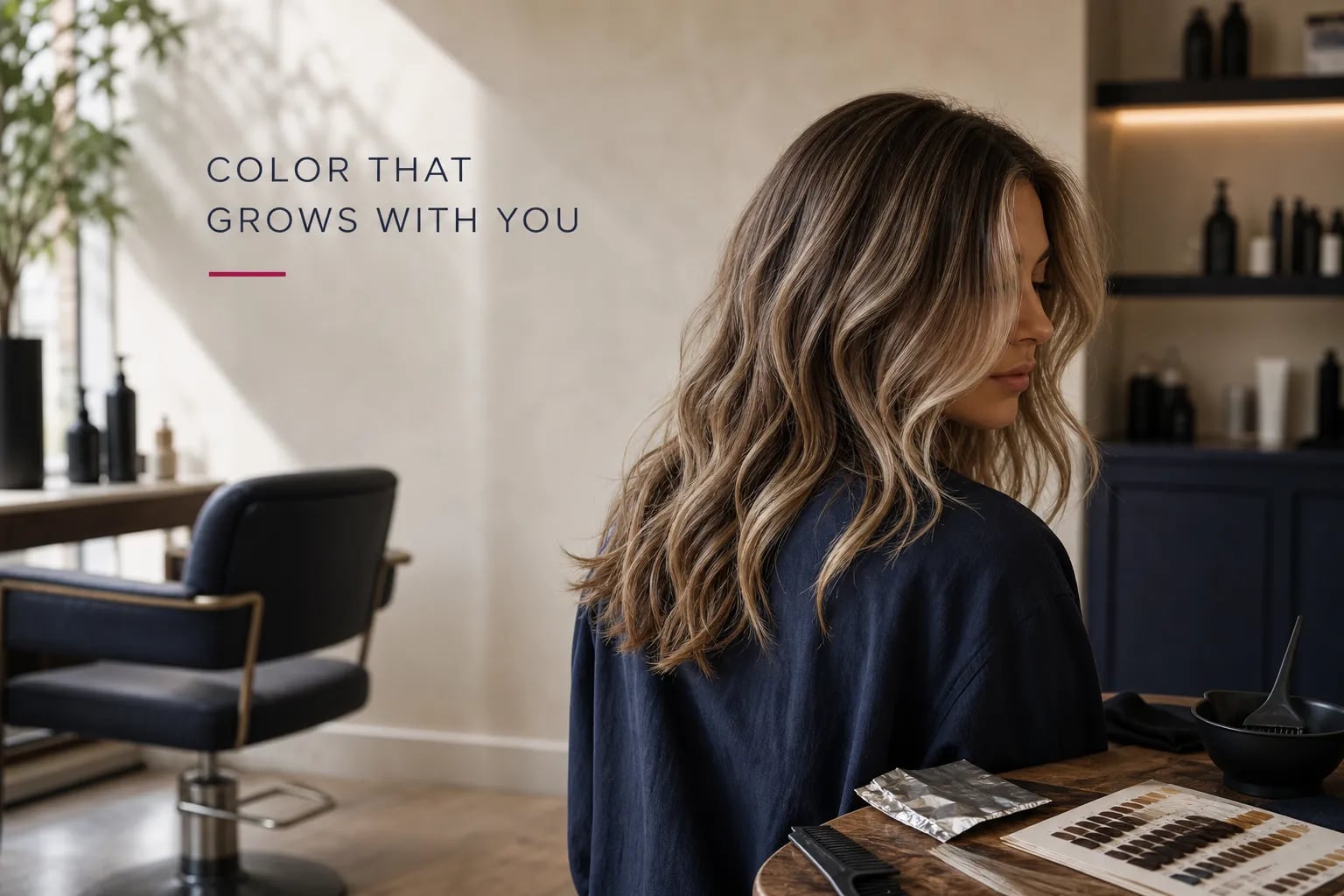
Balayage places color away from or softly into the root using a hand-painted freehand technique that creates a diffused, sun-kissed effect rather than a clean line. Because the root is never fully saturated, regrowth reads as natural depth rather than contrast. That’s why balayage consistently tops the list of low maintenance hair color options recommended by colorists.
Realistic touch-up intervals land around 12 to 16 weeks on average. More subtle placements close to the natural base can stretch to four or six months. On brunette hair especially, the grow-out phase often looks like a feature rather than a flaw, the shadow root simply deepens and enriches the overall dimension over time.
Lived-in color: the look that’s designed to already look grown-in
Lived-in color is a coloring style rather than a single technique. It typically combines soft highlights, shadow roots, and color melting to mimic hair that has evolved naturally over time. The result is dimensional, slightly rooted, and deliberately relaxed from day one.
Because the look starts rooted and intentional, the grow-out has nowhere obvious to go wrong. On dark brunette hair, the shadow at the root deepens gradually over three to six months while the lighter pieces soften naturally. On light brown hair, the transition is even more seamless because the natural base and colored lengths are already close in depth. Lived-in color consistently produces the least noticeable grow-out of any technique, and that’s not an accident.
Root melts and root smudging: blurring the line on purpose
These two techniques are related but distinct. A root smudge applies a soft toner or demi-permanent color at the root and pulls it down about one to three inches, creating a blur between natural growth and lighter lengths. A root melt goes further, blending multiple shades from root through mid-shaft to create a seamless color gradient rather than a soft edge.
Both are especially useful for women who want brighter ends or highlights but don’t want a stark line forming as their roots come in. A root smudge is quicker and more subtle; a root melt is more involved and more seamless. Either way, the goal is the same: grow-out that looks like part of the design.
Choosing Low Maintenance Hair Color for Your Base and Schedule
Matching your technique to your natural hair color
Your natural base determines how much technique flexibility you actually have. Light brunettes and blondes can stretch balayage the furthest because root contrast is naturally low, new growth blends into the colored hair without drawing attention. Darker bases benefit most from root melts and shadow root techniques, since keeping depth at the scalp mirrors the natural root pattern and softens the line as color grows out.
Rooted blondes, where brightness lives through the lengths and ends with intentional depth at the root, work well for women who want contrast and dimension but can commit to a four to eight week refresh. The look is bold, but the formula is honest about the root from the start, which makes maintenance more predictable.
Realistic touch-up timelines to plan your year around
Here’s the practical comparison: balayage typically runs 12 to 16 weeks between appointments, with some subtle placements stretching to six months. Full single-process color needs a root touch-up every four to six weeks. Rooted blondes fall around four to eight weeks depending on how bright or blended the finish is.
Put that in annual terms. Balayage means roughly three to four salon visits per year for color. Single-process means eight to twelve. The difference in time, cost, and chair hours adds up fast. Choosing the right technique isn’t just an aesthetic decision, it’s a lifestyle one, and it’s worth getting right from the start.
Gray-blending color that doesn’t demand constant appointments
Why dimensional color outperforms full coverage for low maintenance
All-over permanent color creates the hardest grow-out line of any technique, especially when gray is involved. When solid color meets silver root, the contrast is sharp and immediate. Dimensional techniques handle this far more gracefully. Mixed highlights, lowlights, and balayage break up the gray so regrowth reads as part of the overall look rather than an obvious line of contrast.
The principle is the same as any low maintenance hair color approach: soften the transition from root to length, and the grow-out becomes invisible. A skilled colorist uses this to build gray blending that looks intentional at week six and still looks polished at week fourteen.
The shades that work with gray, not against it
Colorists consistently reach for cool ashy blondes and champagne blondes when blending gray, because light tones create less contrast with silver regrowth. For brunettes, warm neutral shades like chocolate, caramel, honey, and chestnut blend most naturally because they stay close to the natural base without going so dark that regrowth creates strong contrast.
A useful tip: go one shade lighter than your target when blending gray. Slightly lighter formulas tend to blend more softly and avoid a flat or overly saturated result. Semi-permanent color is also worth discussing with your colorist if you want gray blended rather than fully covered, since it fades gradually and leaves no hard line as it grows out.
The at-home routine that stretches color further
Washing and conditioning habits that preserve your tone
Over-washing is one of the fastest ways to accelerate color fading. Stretching washes to two or three times per week reduces how often pigment is stripped from the hair shaft. Every wash with a sulfate-free, color-safe shampoo and conditioner helps, but washing less often helps more. Rinsing with cooler water and keeping hot-tool temperatures lower are two small adjustments that make a measurable difference in how long your tone holds true.
These habits aren’t complicated, but they’re the baseline. Skipping any one of them regularly means your color fades faster than it should, and your next appointment comes sooner than planned.
The products worth adding to your weekly routine
Beyond your everyday shampoo and conditioner, a few weekly additions give your color a meaningful boost. A hydrating or bond-repair mask keeps hair integrity strong, which translates directly to color that looks fresher longer. A weekly gloss, toning glaze, or color-depositing mask refreshes tone and seals the cuticle between salon visits. For blonde and balayage clients, a purple or blue-toned shampoo addresses brassiness before it becomes the main story.
Dry shampoo earns its place in the routine as a practical tool for buying extra time between wash days without adding more wash cycles to the week. For clients who want professional-grade results at home, premium lines like Kérastase and Innersense, both available at Harlow, are formulated specifically for color-treated hair and deliver noticeably better protection and feel than generic drugstore alternatives.
How a great colorist builds low maintenance into the formula from the start
Why the consultation matters more than the shade itself
Choosing a technique is one piece of the puzzle. How a colorist applies that technique, calibrated to your specific root speed, natural base, hair health, and schedule, is what actually determines how long the color holds up. Two clients can both request balayage and leave with results that last three months apart from each other, depending on how thoughtfully the formula and placement were built.
At Harlow Beauty and Hair Salon on Burnet Road in North Austin, every color service begins with exactly that kind of consult-led conversation. The placement, the depth, the transition point, all of it is designed to look intentional months after the appointment, not just on the day. That detail-obsessed approach is the difference between color that performs and color that requires constant management.
What to ask for when you book your next color appointment
Walk into your next appointment with a few specific pieces of information ready. Tell your colorist how often you realistically want to sit in the chair, your natural base color, whether you’re working with gray, and what grow-out you’re comfortable living with between visits. Those four points give a skilled colorist everything needed to recommend the right technique, the right placement, and the right formula for your actual life.
If your colorist doesn’t ask those questions first, that’s worth noticing. The best color work starts with understanding your life, not just your hair.
The smarter version of great color
Low maintenance hair color isn’t a lesser version of a bold salon look, it’s a smarter one. Start with a technique that grows out softly, keep the shade close to your natural base, and back it up with a simple at-home routine that preserves tone between visits. Those three moves handle most of the work before you ever return to the chair.
Balayage and lived-in color are your most forgiving options for most bases. Root melts step in where you need a cleaner gradient. Gray-blending performs best when it’s dimensional rather than solid. And no technique delivers its best without a colorist who designs the grow-out into the formula from the start.
If you’re in North Austin and ready to stop managing your color and start enjoying it, Harlow matches you with the right specialist before you ever sit in the chair, based on your goals, your hair, and your actual schedule. Reach out to the team to get matched and start the conversation about color that works for your real life.