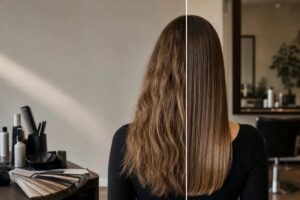
You step outside on a Tuesday morning in Austin, hair freshly blown out, and within ten minutes the humidity has undone every bit of it. If you’ve lived here through a Texas summer, you know exactly what that feels like. It’s not a vanity problem, it’s a daily battle against a climate that averages around 67% relative humidity, higher than the national average and relentless in the warmer months. The keratin treatment benefits that so many North Austin clients report come down to exactly this context: not indulgence, but a practical response to real conditions.
A keratin smoothing treatment is a protein-based salon service that works by flooding the hair with additional keratin, then sealing it into the cuticle with flat-iron heat. The result is a smoother, more uniform surface that resists moisture and holds its shape. It’s a frizz management system, not a straightening treatment in the traditional sense. At Harlow Beauty and Hair Salon in North Austin, we tailor keratin services specifically for clients with color-treated and balayaged hair, where the chemistry involved requires a careful, experienced hand.
By the end of this article, you’ll know whether a keratin treatment fits your hair type, your lifestyle, and your budget. You’ll also know what to ask before you book anywhere.
What a keratin smoothing treatment actually does to your hair
Hair is naturally made up of keratin protein, but heat styling, color processing, and environmental stress break those bonds down over time. When the cuticle becomes roughened and uneven, hair absorbs moisture from the air and swells, that’s what causes frizz. A professional keratin treatment floods the hair shaft with additional protein, which is then bonded into the cuticle using the heat of a flat iron. The result is a smoother surface that reflects light more evenly and resists humidity.
It’s worth understanding the distinction between treatments that genuinely bond protein into the hair’s cortex versus products that simply coat the surface. Surface-coating treatments wash out in a matter of weeks. A true professional keratin system penetrates deeper, which is why results from a proper in-salon service last months rather than weeks.
What the appointment actually looks and feels like
The in-salon process is more straightforward than most clients expect. Your stylist applies the keratin solution to clean, dry or damp hair, allows it to process, then seals it in with a flat iron at high heat. The appointment typically runs two to four hours, depending on your hair’s length and density. Most formulas require a waiting period before your first wash, usually somewhere between 24 and 72 hours, to let the bonds fully set. When you’re in the hands of a trained professional, the process is calm, methodical, and very manageable.
Keratin treatment benefits: what clients keep coming back for
The keratin treatment benefits that drive such a loyal following aren’t a mystery. The results are measurable and show up in daily life in very concrete ways. Here’s what clients consistently report after a professional service.
Frizz reduction that’s genuinely noticeable
This is consistently the number one reason clients book. Professional formulas reduce frizz by 60% to 90%, depending on hair texture and the specific treatment used, a range supported across multiple salon-based assessments and product studies. For someone with thick, curly, or humidity-prone hair in Austin, that’s the difference between fighting your hair every morning and actually walking out the door on time. What used to require a full bottle of smoothing serum and two passes with a flat iron holds with minimal product afterward, a commonly reported shift among clients, though individual results vary. The before-and-after is not subtle.
Faster morning routines, by real numbers
Client feedback and stylist-tracked outcomes consistently show that blow-dry and styling time drops by 30% to 60% after a keratin treatment. Some clients go from a 35-minute blowout to about 15 minutes. That’s not a vague “it’s easier to manage”, that’s a measurable shift in your daily schedule. For the busy professional who’s out the door before 7 a.m., this is one of the most practical keratin treatment benefits the service delivers, and it compounds over months of consistent results.
Smoother texture, more shine, and less mechanical damage
Beyond frizz control, clients report hair that feels significantly softer and looks visibly shinier. One outcome documented in professional product evaluations is a meaningful increase in shine, some reports cite figures in the range of 40% to 50%, which happens because the sealed cuticle reflects light more evenly instead of scattering it. Color-treated hair benefits especially from this, since bleaching and toning naturally lift and roughen the cuticle. Improved manageability also means less daily wrestling with the hair, which reduces the mechanical damage from brushing, detangling, and re-styling over time.
Keratin treatment benefits: how long results last and what changes the timeline
Setting accurate expectations upfront leads to better outcomes. Clients who understand the timeline tend to follow aftercare instructions more carefully, and they’re happier with results because they’re not caught off guard when things eventually fade.
Express vs. traditional keratin treatments
Express keratin treatments typically last four to eight weeks. Traditional in-salon formulas last three to six months, with good aftercare pushing results toward the upper end of that range. The tradeoff is time and cost: express treatments are faster and more affordable but require more frequent appointments. If you’re on a tight schedule and want a low-commitment introduction to the service, an express treatment makes sense. If you want maximum longevity and are willing to invest in the full process, a traditional salon formula is the better fit.
One important note for anyone with bleached or balayaged hair: because color-treated hair has a more open, porous cuticle, the treatment may fade somewhat faster than on virgin hair, often in the six-week to two-and-a-half-month range. This makes aftercare even more important for color clients.
What shortens (or extends) your results
The biggest variables are washing frequency, product choice, and water exposure. Sulfate-heavy shampoos strip the treatment faster than almost anything else. Chlorinated and salt water are also culprits. Coarse, thick hair tends to hold the treatment longer than fine hair because of the structural difference in how the protein bonds. The protective habits are simple: switch to a sulfate-free shampoo, aim to wash no more than three to four times per week, and protect your hair before swimming. Kérastase Discipline Bain Fluidealiste is a solid professional option for post-keratin color-treated hair and one we carry at Harlow, ask us about it during your appointment.
Which hair types get the best results (and who should wait)
Being honest about candidacy is more useful to you than a universal sales pitch. Keratin smoothing treatments work beautifully for certain hair types and can cause problems for others.
Hair that responds best
Thick, coarse, curly, wavy, and frizz-prone hair types see the most dramatic results. Color-treated hair in reasonable condition also responds well, gaining both smoothness and improved shine from the added protein. Wavy hair that turns poufy in humidity is one of the most common success stories we see at Harlow. The treatment also works well alongside balayage and highlights, as long as the hair isn’t severely compromised, and can actually enhance the visual depth and shine of dimensional color work.
When it makes more sense to wait
Very fine or thinning hair can look flatter and lose volume after a keratin treatment, which is often the opposite of what fine-haired clients need. Severely over-processed or heavily bleached hair with significant breakage is also a poor candidate, the additional heat and chemical interaction can worsen existing damage rather than help it. Pregnant or breastfeeding clients, and those with asthma or chemical sensitivities, should consult a physician before booking, particularly with any formula that isn’t fully formaldehyde-free. A good stylist will tell you honestly if you’re not a strong candidate. If a salon pushes the service regardless of your hair’s current condition, that’s a red flag worth taking seriously.
The formaldehyde conversation: what to actually know
Clients ask about this more than almost any other topic, and it’s one some salons avoid addressing clearly. Here’s a straightforward look at what the research and professional guidelines actually say.
What formaldehyde exposure means in practice
Some older keratin formulas release formaldehyde when activated by flat-iron heat. At high concentrations, formaldehyde irritates the eyes, nose, throat, and lungs. Repeated occupational exposure, the kind stylists face working with these products daily, carries more serious health implications, which is why proper salon ventilation standards exist and matter. For a client receiving a single treatment in a well-ventilated salon, the risk profile is considerably different than it is for someone applying these formulas multiple times a day. Both contexts deserve transparency, not alarm and not dismissal.
Formaldehyde-free formulas and what to ask before booking
The professional market has moved significantly toward formaldehyde-free keratin treatments in recent years, with many brands delivering strong smoothing results without the same exposure concerns. Brands like Cezanne, Magic Sleek, Brazilian Blowout Zero+, and Keratherapy are frequently mentioned in professional salon circles as formaldehyde-free options. One important caveat: “formaldehyde-free” labeling can sometimes mask formaldehyde-releasing chemistry in the formula. Before booking, ask specifically whether the product is formaldehyde-free and aldehyde-free, and request the Safety Data Sheet or full ingredient list if you have sensitivities. Also ask about the salon’s ventilation setup. A professional salon that specializes in these services will answer this question directly and without hesitation. Vagueness about the chemistry of products being used on your hair is a reasonable reason to look elsewhere.
Aftercare, cost, and why your choice of salon matters
The treatment is only half the equation. What you do in the weeks after largely determines whether your results last three months or six.
Aftercare habits that protect your investment
Switch to a sulfate-free, sodium-chloride-free shampoo immediately after your service and keep it as your permanent shampoo going forward. Try to wash your hair no more than three to four times per week if your lifestyle allows. Before swimming in a pool or the ocean, apply a protective oil or use a swim cap. These habits are simple, but they’re the single biggest factor in how long your results hold. Clients who follow these guidelines consistently tend to land at the six-month end of the timeline rather than the three-month end.
What the service costs and why expertise is worth it
In U.S. salons, professional keratin treatments typically range from $200 to $500 or more, depending on hair length, density, and the salon’s expertise level. Shorter hair at a mid-range salon might fall closer to $200 to $300, while long or very dense hair at a premium salon can reach $500 or beyond. For clients with color-treated or balayaged hair, spending more at a salon that genuinely understands the chemistry involved is the smarter investment. At Harlow Beauty and Hair Salon on Burnet Road in North Austin, keratin smoothing treatments are customized for color clients specifically, with formula and heat adjustments made based on your hair’s current health. That matters because the wrong heat setting or formula on compromised hair doesn’t just underperform, it can set your hair health back.
Keratin treatment pros and cons: is this service right for you?
To put it plainly: the keratin treatment benefits are real, measurable, and meaningful for the right candidate. Substantial frizz reduction, noticeably faster styling, improved shine, and months of easier mornings are outcomes that hold up across hair types and textures. The tradeoffs, upfront cost, aftercare commitment, the need for a skilled application, are manageable when you go in with clear expectations.
Results are most reliable when the formula is matched to your hair’s current condition and the stylist understands color chemistry well enough to protect your existing work. The biggest variable in your outcome isn’t the brand of treatment, it’s the skill and judgment of the person applying it. For anyone in North Austin dealing with frizzy, humidity-affected, or color-treated hair, Harlow Beauty and Hair Salon is the right place to start that conversation. Our team gives you an honest assessment of your hair before recommending anything, and we make sure whatever we do works with your color, not against it.
If you’re curious whether this service makes sense for your hair and your lifestyle, reach out and book a consultation. It’s the best way to make sure you get results you’ll actually love, and our team is happy to walk you through your options at no charge.