You spent three hours in the salon chair getting a balayage that perfectly frames your face. The color is dimensional, the highlights sit exactly where you wanted them, and you finally feel like your hair matches the version of yourself you had in mind. Then summer hits, the humidity climbs, and every morning becomes a battle with frizz that undoes all of it. The obvious solution is a keratin smoothing treatment. The obvious fear is watching that color investment wash down the drain along with the frizz.
Understanding keratin treatment before and after results for color-treated hair is one of the most common conversations we have at Harlow Beauty and Hair Salon in North Austin. Color-treated clients want smoother, lower-maintenance hair, but they’re not willing to sacrifice their tone, their dimension, or their highlights to get it. The good news is they don’t have to. The before-and-after results documented here reflect what our team sees regularly on balayaged and color-treated clients: smoother texture, richer color appearance, and mornings that no longer require a 40-minute styling session, all without meaningful tonal sacrifice. But getting there requires the right sequence, the right formula, and intentional aftercare. Here’s the honest breakdown.
What keratin actually does to color-treated hair
Keratin treatment before and after for color-treated hair: visible changes most clients notice
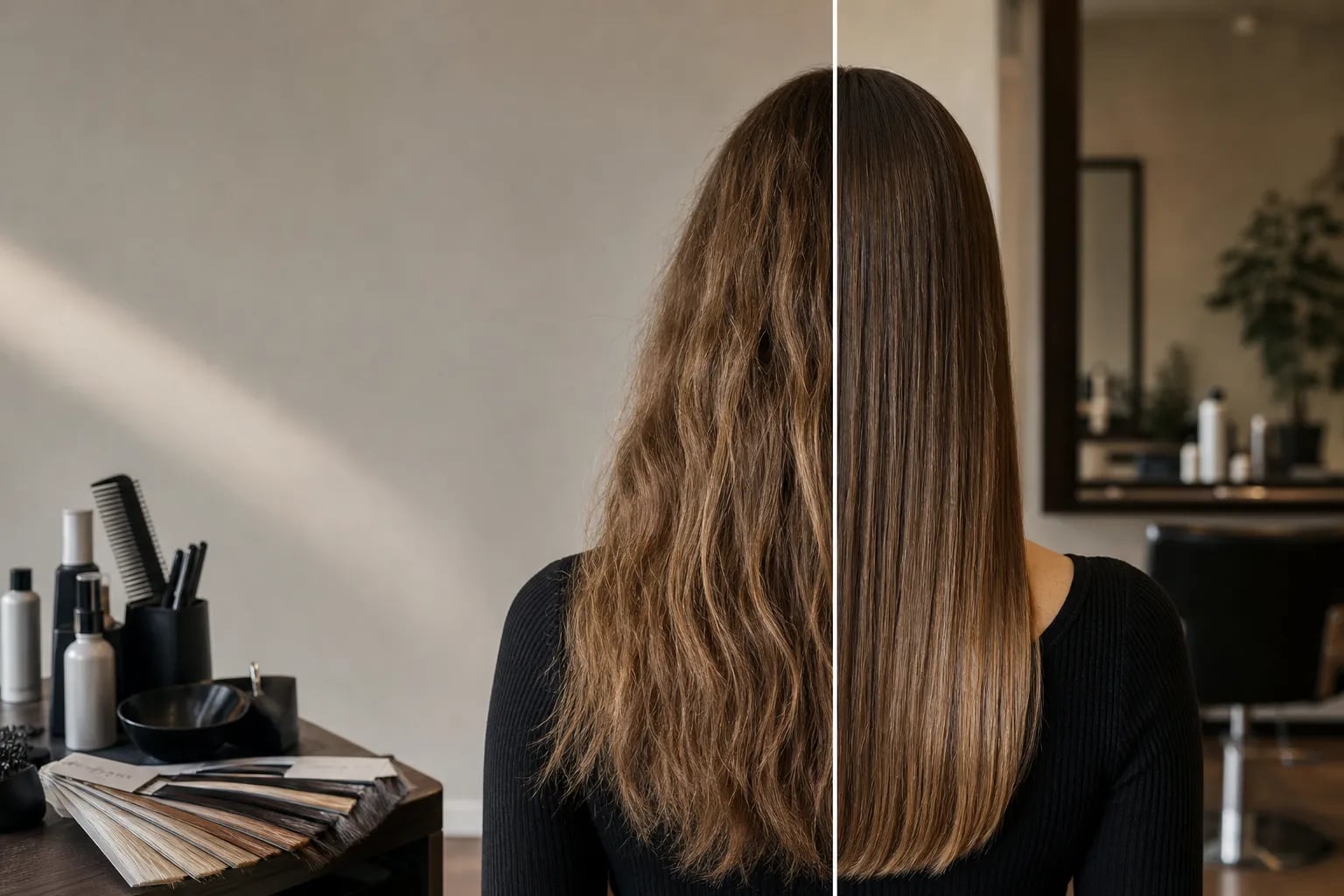
A keratin smoothing treatment works by coating and temporarily sealing the hair cuticle, the outermost layer of each strand. When that cuticle lies flat, the hair surface reflects light more evenly, frizz disappears, and blow-dry time drops dramatically. For most clients, the before image tells a clear story: porous, color-treated hair that absorbs moisture unevenly, looks slightly dull even right after washing, and requires 30 to 45 minutes of heat styling just to look presentable.
The after image is different in ways that surprise clients. Yes, the frizz is gone. But color-treated hair that was looking flat or slightly brassy before the service often looks richer and more dimensional immediately after. The sealed cuticle that stops frizz also stops light from scattering unevenly, so your balayage or dimensional brunette work reads with more depth and gloss than it did before. This is the result that clients in our North Austin portfolio consistently show: the tones are the same, but they appear more intentional, more saturated, and significantly shinier.
What keratin does not change
Keratin does not alter your underlying hair color, change your growth pattern, or repair structural damage at the cortex level. That distinction matters, keratin is a temporary cuticle treatment, not a structural repair service. If your hair is compromised from bleach or repeated heat, a keratin treatment will make it feel and behave better, but it won’t rebuild what’s been lost. Expectations need to be set clearly here, because the number one source of post-service disappointment is a client who expected a transformation the service was never designed to deliver. Keratin smooths and seals; it does not rebuild.
Tonal shifts by color type: what the before-and-after really looks like
Balayage, brunettes, and dimensional color
Keratin and balayage are genuinely compatible. The smoothed cuticle makes balayage look glossier and more blended rather than scattered or frizz-diluted. Dimensional brunette color often appears richer and deeper immediately after the service, because the sealed surface amplifies the contrast between lighter and darker tones rather than flattening it. The before images on these clients typically show slightly lifted, frizz-prone color with uneven light reflection. The after images reveal the same tones with noticeably more depth, more gloss, and a finish that holds longer between washes.
Blonde, red, and fashion-shade hair
These color categories require more careful handling. Very light blondes, bleached hair, coppers, reds, and pastels are all more sensitive to the high heat used during the flat-iron sealing step. On very blonde or bleached hair, some clients experience a shift of one to two tones lighter. Reds and coppers can experience subtle tonal muting, especially when the color is still fresh. This is not an inevitable outcome, it depends heavily on formula choice, heat settings, and timing between services. If your hair falls into one of these categories, ask specific questions before you book, not after.
Why timing between color and keratin is the most important variable
Keratin treatment before and after for color-treated hair: getting the sequence right
The safest sequence is consistent across professional guidance: color first, then wait 7 to 14 days before applying a keratin treatment. Fresh color sits in an open cuticle. Apply the heat and chemistry of a keratin service too soon, and the process can displace pigment before it has fully bonded to the hair shaft. The result is uneven fading, tonal shift, or color that looks washed out within days of the service. Waiting the full one to two weeks allows the pigment to stabilize, so the keratin seals it in rather than lifting it out.
How long to wait after keratin before re-coloring
If you already have a keratin treatment in place and want to add color, the minimum waiting period is two weeks. For stronger formulas or on bleached hair, three to four weeks is the safer window. The reason is that the keratin coating needs time to settle before a color formula can penetrate evenly. Color applied too soon after keratin can behave unpredictably, with patchy uptake or uneven tone distribution as the likely result. Keep the services properly spaced, and both outcomes hold. Rush the timing, and you’re paying for corrections that could have been avoided.
Choosing a keratin formula that won’t compromise your color
Formaldehyde-free and cysteine-based options
Not all keratin treatments are formulated the same way, and for color-treated clients, formula choice is not a minor detail. Formaldehyde-free and cysteine-based treatments are consistently safer because they smooth the cuticle without the aggressive chemical action that can lift it and displace pigment. Low-pH formulas help keep the cuticle sealed during the service rather than forcing it open. One thing worth knowing: some products labeled “no formaldehyde” use formaldehyde-releasing compounds that behave similarly under heat. Ask your stylist directly what the active ingredients are and whether the formula is truly aldehyde-free, not just marketed as such.
Ingredients to look for and what to avoid
When evaluating a keratin formula for color-treated hair, look for hydrolyzed keratin, cysteine or cystine, panthenol, ceramides, and argan oil in balanced concentrations. These ingredients smooth and reinforce without stripping. Avoid sulfate-heavy pre-wash protocols and high-pH formulas, both open the cuticle and accelerate pigment loss. At Harlow, the team selects keratin formulations based on each client’s existing color level, hair porosity, and color type before committing to a product. The same consult-first approach that shapes our color and extension services applies here. There is no single formula that works best for every person, and any salon suggesting otherwise is cutting corners.
What happens during a color-safe keratin appointment
Questions to ask before you sit in the chair
Asking the right questions before you book is the single most effective way to protect your color. Start with these: What formula do you use, and is it genuinely formaldehyde-free? What iron temperature do you use on color-treated hair, and how does that change for bleached or highlighted hair specifically? How do you adjust the process based on a client’s porosity? A stylist who answers those questions clearly knows the service, one who just reassures you probably doesn’t.
Salon-day protocol: what the service should include
The actual service follows a clear sequence: clarifying wash, formula application, a processing window that allows the treatment to penetrate, and the flat-iron sealing pass. For color-treated hair, the flat-iron temperature should stay at or below 380°F, with one clean pass per section rather than multiple high-heat passes through the same hair. Higher-porosity hair, common on color-treated and bleached clients, absorbs the treatment more readily but also tolerates less heat during the sealing step. A skilled stylist adjusts for this rather than running every client through the same heat protocol. At Harlow, where keratin is part of a full color-service offering, heat settings are calibrated to each client’s current hair condition, not a standard preset.
Post-keratin care to keep your color and smoothness intact
The first 72 hours: what you must not do
The first three days after a keratin treatment are the highest-risk window for both treatment disruption and accelerated color fade. No washing. No sweating. No ponytails, no tucking hair behind your ears, no hats, no headbands. Hair needs to stay dry, straight, and uncreased while the keratin finishes curing. Any friction, moisture, or creasing during this window creates uneven areas where the treatment breaks down faster. On color-treated hair, those same spots tend to fade faster too, creating patchy results that are difficult to correct without re-doing both services.
Long-term maintenance to protect both results
After the initial 72-hour window, the goal shifts to preserving both the smoothness and your color through daily habits. Switch permanently to a sulfate-free, color-safe shampoo and conditioner. Wash with lukewarm or cool water, which keeps the cuticle flatter and reduces pigment loss with every wash. Blot your hair dry rather than rubbing it. Use a heat protectant every single time you reach for a hot tool, and keep styling temperatures conservative. Avoid chlorine, saltwater, and hot tubs, especially in the weeks immediately following the service. Sleep on a silk or satin pillowcase to reduce overnight friction.
For blondes and highlighted clients, use a purple toning shampoo only as needed to manage brass, routine use strips color and keratin alike, so targeted application is smarter than building it into every wash. Deep condition every one to two weeks to maintain both softness and color depth. Plan to repeat a full keratin treatment no sooner than every three to four months for most color-treated clients, and every four to six months for bleached or fine hair. Repeating too frequently leads to protein buildup, which shows up as stiff, brittle, straw-like texture and dull color rather than the smooth, healthy result you’re after.
Before-and-after keratin treatment on color-treated hair: the results worth knowing
The core takeaway is straightforward: keratin treatment and color-treated hair are compatible when the sequencing is right, the formula is appropriate, and the aftercare is intentional. Most clients see their color look better after a keratin treatment, not worse, because the sealed cuticle makes color appear richer and more true-to-tone. The risk of tonal shift exists for very blonde, bleached, red, and fashion-shade hair, and it is avoidable with the right stylist, the right formula, and carefully observed timing.
The keratin treatment before-and-after difference that matters most isn’t just frizz reduction. Your balayage suddenly reads the way it was designed to. Your brunette looks dimensional instead of flat. And your mornings get significantly easier without sacrificing the color work you invested in. That combination is achievable, but it requires a stylist who understands both services at the same level rather than treating them as independent appointments.
If you are in North Austin and want to see what keratin treatment before and after results look like on balayaged or color-treated hair before committing, reach out to our team at Harlow Beauty and Hair Salon. We offer consultations that match you with the right stylist and service plan based on your current hair condition, color history, and goals. No guesswork, no blanket approach, and no compromising your color to get the smoothness you want.
Frequently asked questions
What should I expect before and after a keratin treatment on color-treated hair?
Before the service, color-treated hair is often porous, prone to frizz, and can look dull between washes. After a properly timed and formulated keratin treatment, the cuticle lies flat, which reduces frizz significantly and makes color appear richer and more dimensional. Most clients with balayage or brunette tones see their color improve in appearance, not fade. Blondes, reds, and fashion shades need a more careful formula approach to protect their tone.
When should I color my hair before or after a keratin treatment?
Color first, then wait 7 to 14 days before your keratin appointment. If you want to color after a keratin treatment, wait at least two weeks, and up to four weeks if your hair is bleached or the formula was strong. Rushing either window risks uneven color uptake, accelerated fading, or tonal shifts that are hard to correct without starting both services over.
Will keratin make my color fade faster?
When timed and applied correctly, a keratin treatment actually helps color last longer by sealing the cuticle. Color fade is most likely when keratin is applied too soon after coloring, when a high-pH or sulfate-heavy formula is used, or when the flat-iron temperature is too high for the hair’s current condition. Choosing a formaldehyde-free formula and following proper aftercare are the two most effective ways to prevent premature fade.