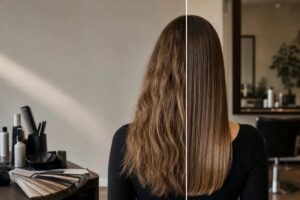

You step outside on an August morning in North Austin, hair smooth from last night’s blowout, and by the time you reach your car the humidity has already made its opinion known. That puffed-up, rough-surfaced result isn’t a styling failure. It’s a physics problem, and most products aren’t actually solving it. They’re managing it temporarily, at best. If you’ve been hunting for a frizzy hair solution that holds through a Central Texas summer, the issue usually isn’t effort, it’s alignment between your hair’s structure and what you’re putting on it.
The reason so many frizz-control products disappoint is straightforward: many mass-market formulas assume a one-size-fits-most approach, which may not suit every hair type or climate. What works beautifully for someone with fine, low-porosity hair in a dry California city can completely fail someone with chemically treated, high-porosity hair navigating Central Texas summers, where humidity regularly sits between 65 and 75 percent. Matching the solution to your hair’s actual structure is what separates a product that works all day from one that gives up by 10 a.m.
This guide is ranked by effectiveness, from targeted daily products all the way up to professional treatments. Read straight through or jump to the section that fits your hair type and lifestyle.
Why your hair gets frizzy (the real reason products fail you)
The cuticle-humidity connection
Frizz isn’t a personality trait your hair was born with. It’s your hair’s outer cuticle layer reacting to moisture imbalance. When the cuticle is healthy and flat, strands lie smooth and reflect light evenly. When it’s lifted or damaged, humid air moves into the hair shaft, causes it to swell unevenly, and turns the surface rough and puffy. The same hair can look polished on a dry afternoon and completely unruly after a single humid morning, because the cuticle is responding to what’s in the air around it.
How hair porosity determines your frizz type
High-porosity hair, which includes most chemically processed, heat-damaged, or naturally porous hair, absorbs humidity faster and more unevenly. That absorption causes the dramatic, high-volume frizz most people picture. Low-porosity hair behaves differently: it resists moisture going in, which may lead to surface dryness and static rather than puffing. Knowing which type you have changes everything about which frizzy hair solutions will actually help. A deep moisturizing mask is the right call for high-porosity hair; it can weigh down low-porosity hair without delivering real benefit.
What heat and color do to frizz over time
Repeated blow-drying, flat-ironing, and chemical color services gradually lift and erode the cuticle. This is why a product that worked two years ago might feel less effective now. The hair’s structural integrity has shifted, and the old routine can’t compensate for new levels of damage. This progression is also why frizz tends to get worse at the ends first: those sections have been processed the most times and are the farthest from scalp oils that would otherwise protect them.
The ingredients that genuinely fight frizz
Dimethicone and silicones: the smoothing shield
Silicones, especially dimethicone, work by forming a smooth film around each strand, physically sealing the cuticle against humidity. They don’t just add moisture; they create a barrier that limits how much the hair can absorb from the air. This is the most consistently supported mechanism in frizz control, and it explains why so many high-performing anti-frizz serums list dimethicone near the top of their ingredient list. Coarse, frizzy, or color-treated hair benefits most from silicone-forward formulas, especially in humid climates.
Oils and their cuticle-smoothing role
Argan, coconut, marula, and jojoba oils smooth the cuticle, reduce friction between strands, and add a layer of humidity resistance. Coconut oil is unique in that it can actually penetrate the hair shaft rather than just coating the surface, which makes it useful as both a pre-wash treatment and a light finishing touch. Fine hair should use oils sparingly, focused on the ends, because too much weight causes limpness and reduces the volume that fine-haired people are usually trying to protect.
Glycerin and keratin: moisture management vs. structural repair
Glycerin draws moisture into the hair shaft and works well in moderate humidity environments. In very high humidity, like a Texas August, it can pull too much water in and make frizz worse rather than better. Keratin takes a different approach entirely: it fills in damaged areas along the hair shaft, restoring structure rather than managing moisture. For porous, chemically treated, or weakened hair, keratin-based products address the root cause of frizz instead of just layering over it.
At-home frizzy hair solutions ranked by effectiveness
Best products for curly and wavy hair
Moisture-rich, curl-defining formulas consistently outperform generic smoothing products for waves and curls. SheaMoisture Coconut and Hibiscus Curl and Shine Shampoo adds slip and moisture that helps curls clump cleanly instead of separating into frizz. Pattern Beauty Hydration Shampoo performs especially well for tighter coil patterns. The Living Proof No Frizz line handles softer curl patterns and delivers strong humidity resistance without leaving a sticky finish. Pair any of these with a leave-in conditioner and a lightweight curl cream to define curl shape and lock out humidity before you diffuse.
Best picks for straight and fine hair
Straight and fine hair needs frizz control without the weight that makes it fall flat. Redken Frizz Dismiss is the most reliable weightless option in this category, with a humidity-resistant formula that doesn’t sacrifice body. Garnier Fructis Sleek and Shine is a solid budget option that delivers real smoothing for everyday use. For finishing, a light silicone serum like John Frieda Frizz Ease works better than oils on fine hair. Oils can flatten strands and reduce the lift that anyone with fine hair is usually trying to maintain.
Home remedies with real benefit
A pre-wash coconut oil treatment is the best-supported DIY option for reducing frizz at home. Apply a small amount, about half a teaspoon for fine hair, slightly more for thick, to dry hair, focus on the mid-lengths and ends, and leave it on for 20 to 30 minutes before shampooing. It penetrates the shaft, reduces protein loss, and helps strands resist humidity uptake. Always shampoo thoroughly afterward, double-shampooing if needed, to prevent buildup that can weigh hair down.
A diluted apple cider vinegar rinse, roughly one to two teaspoons in one cup of water, can temporarily smooth the cuticle by lowering the hair’s pH. This works best as an occasional reset for high-porosity hair that’s prone to roughness, rather than a daily step. Always rinse it out completely, and skip it entirely if you notice scalp irritation.
Building a wash-day routine that keeps frizz away
Wash day: from shampoo to styling
Start with a sulfate-free, moisturizing shampoo. Sulfates strip the cuticle’s natural protection, which makes frizz progressively worse with each wash. Kérastase Discipline Bain Fluidealiste and Living Proof No Frizz are two stylist-recommended sulfate-free options that deliver smoothing without compromising hair health. Follow with a conditioner that contains dimethicone or an oil-based emollient, focusing on the lengths and ends.
After rinsing, resist the urge to rub hair with a terry cloth towel. The friction lifts the cuticle immediately and undoes what your products just did. Use a microfiber towel or a cotton T-shirt to press out moisture instead. Apply a leave-in treatment or anti-frizz serum while hair is still damp, then diffuse or air dry based on your texture. Heat applied to frizzy, already-porous hair without a heat protectant accelerates the cuticle damage that started the frizz cycle in the first place.
Daily frizz control between wash days
On non-wash days, a lightweight finishing cream or a few drops of argan oil pressed through the mid-lengths can calm flyaways without resetting your style. A satin pillowcase makes a genuine difference for overnight friction, which is one of the most underestimated drivers of morning frizz. Avoid touching your hair repeatedly throughout the day. Every pass of your fingers disrupts the cuticle, and the cumulative effect by afternoon is significant.
When a professional treatment is the smarter choice
How keratin smoothing treatments work
A professional keratin smoothing treatment infuses keratin proteins into the hair shaft, then seals them in with heat. The result is a smoother, shinier surface that resists humidity for months rather than hours. Unlike daily products that sit on the surface and can be compromised by a single humid morning, a keratin treatment works from within the strand. Results typically last three to six months with proper aftercare, which means sulfate-free shampoo and less frequent washing to protect the treatment’s integrity.
Why Texas humidity makes professional treatment worth it
Daily products work well under moderate conditions, but North Austin’s summer humidity can overwhelm even the best anti-frizz serum before you finish your morning coffee. For anyone dealing with persistent, product-resistant frizz in a climate like this, a professional keratin smoothing treatment is the most effective long-term frizzy hair solution available. At Harlow Beauty and Hair Salon on Burnet Road in North Austin, stylists assess your hair’s porosity and texture before recommending a smoothing formula, because the wrong treatment can over-process fine hair while under-delivering on thick, coarse strands. That kind of tailored assessment, choosing a smoothing formula by porosity level rather than just general hair type, is what separates a result that lasts through multiple seasons from one that fades well before the three-month mark.
What to expect from your keratin appointment
Treatments typically run two to three hours depending on hair length and thickness. Plan for a waiting period before your first post-treatment wash, usually 48 to 72 hours, and commit to a sulfate-free shampoo from that point forward. Cost at a professional salon generally runs $200 to $500 or more depending on hair volume, length, and the formula used. The investment pays off in reduced daily styling time and consistent smoothness through multiple seasons, a real return for anyone spending 20 minutes every morning fighting the same frizz problem.
- Arrive with hair clean and completely product-free; confirm your salon’s specific pre-appointment prep when you book
- Avoid tight ponytails or clips for the first 72 hours after treatment
- Switch all hair products to sulfate-free immediately to protect the result
- Expect a touch-up at the three to four month mark if you have highlighted or heavily processed hair, as those sections fade faster
Finding the right frizzy hair solution for your hair
For mild, occasional frizz, a consistent wash-day routine built around the right shampoo, conditioner, and finishing serum is usually enough. Swap in a sulfate-free formula, add a microfiber towel and a satin pillowcase, and you’ll see a real difference within a few weeks. For moderate frizz driven by porosity or damage, the right ingredients make the bigger impact once you match them to your hair type. That means silicone-forward products for high-humidity environments, oil-based treatments for damaged and porous hair, and lightweight serums for fine hair prone to frizzing without volume loss.
For persistent, humidity-driven frizz that no bottle on a shelf has been able to fix, a professional keratin smoothing treatment delivers what daily products can’t. If you want a lasting frizzy hair solution and you’re in North Austin, Harlow Beauty and Hair Salon’s team can assess your hair’s texture, porosity, and history to recommend the right smoothing approach for your goals. Reach out before you book to ask about pairing with the right specialist for your hair type. The right match matters just as much as the right treatment.