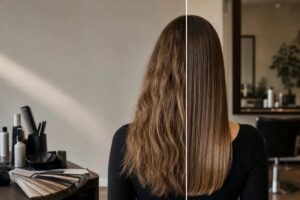
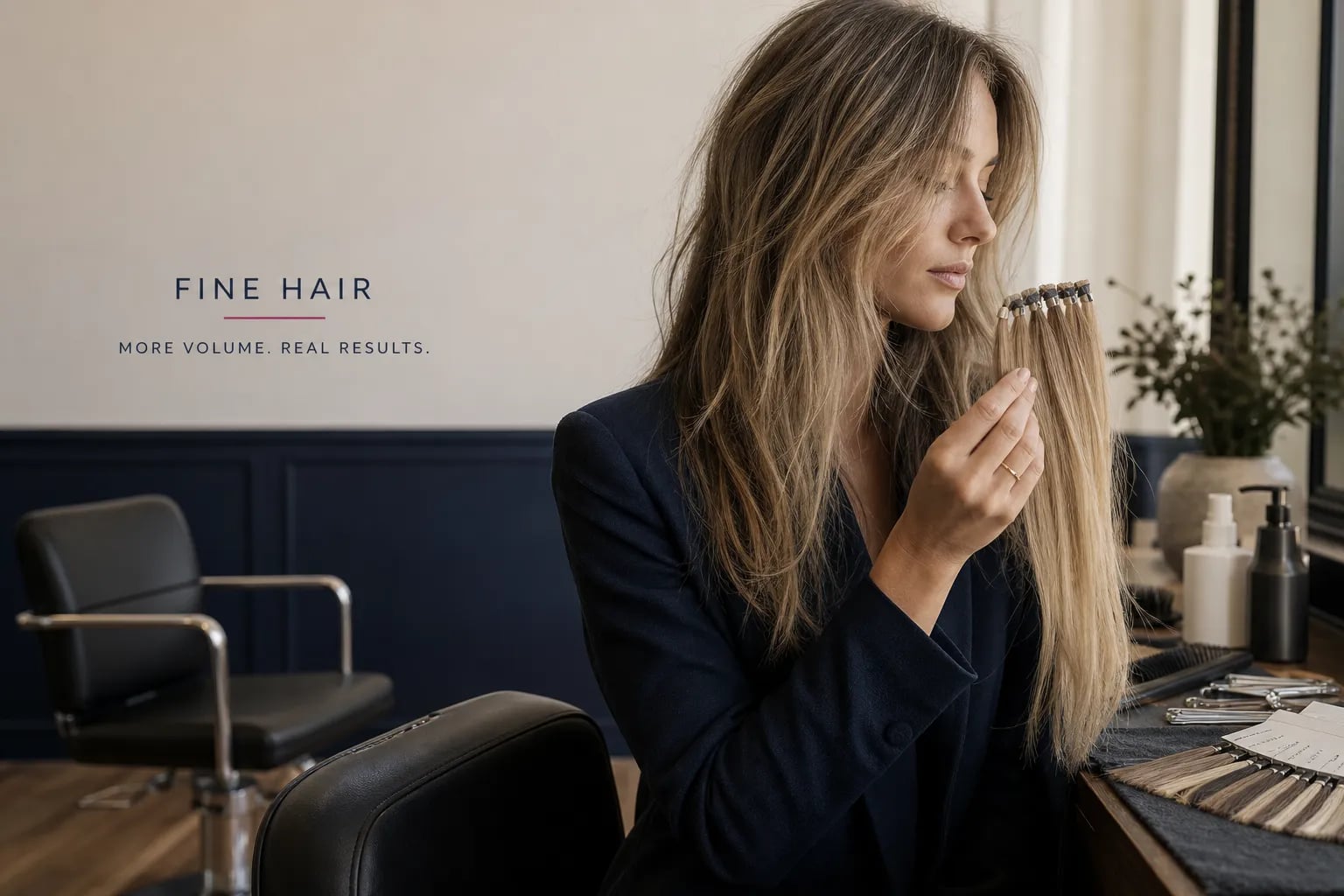
Are hand-tied hair extensions worth it for fine hair? If you have fine hair and you’ve been dreaming about more volume and length, you’ve probably also spent time worrying about whether extensions will destroy what you already have. That fear is completely reasonable. Fine strands have less tolerance for tension, weight, and stress, and the last thing you want is to pay a significant amount of money only to end up with thinner hair than when you started.
At Harlow Beauty and Hair Salon in North Austin, our stylists hear one question from fine-hair clients more than almost any other: “Will hand-tied extensions damage my hair?” It’s not an overreaction. It’s a smart question that deserves a thorough, honest answer based on real client work, not a pitch designed to get you into the chair.
This article breaks down how hand-tied weft extensions actually function on fine hair, what the real risks are, what a skilled specialist does differently, what you’ll spend, and how to maintain your results without sacrificing your hair’s health. By the end, you’ll have everything you need to make a confident decision.
How hand-tied wefts actually work on fine hair
The mechanics of this method matter because they directly affect how safe it is for your hair type. During installation, a stylist places small silicone-lined beads along sections of your natural hair, creating a foundation row close to the scalp. A hand-tied weft, essentially a continuous curtain of extension hair sewn together by hand, is then stitched onto that bead row with thread. No glue, no heat, no individual strand bonding.
For fine hair, this structure is meaningful. Because the weft attaches along an entire row rather than strand by strand, the weight of the extension spreads across multiple anchor points instead of concentrating on one fragile strand. That distributed load is the core reason we recommend this method for finer textures over alternatives like i-tip or micro-bead extensions, which apply load at individual strands and can create more visible stress on sparse hair.
Tape-ins take a different approach: adhesive panels sandwich a thin section of your natural hair and lie relatively flat against the scalp. They can work well for very sparse hair but carry adhesive-related considerations at removal and reinstall. If you’ve seen the term “invisible bead extensions” during your research, some branded systems describe a similar beaded-row approach to the hand-tied weft method. These generally fall into the same category and carry a comparable general risk profile, though specifics can vary by brand and application technique.
The honest damage risk every fine-hair client should understand
Hand-tied wefts are generally lower risk than braided sew-ins or strand-by-strand keratin bonds on fine hair, but the risk is real and not zero. The main concern is traction alopecia, which develops from sustained tension on the hair follicle over time. It’s not sudden breakage; it’s a gradual process that can become permanent if the warning signs are ignored.
Warning signs to watch for
For hand-tied wefts specifically, the risk climbs when rows are too heavy, attachment points are too tight, move-up appointments are skipped, or the hair simply isn’t in good enough condition to support the weight. Early warning signs include scalp tenderness at the attachment points, redness around follicles, small breakage hairs at the temples or front hairline, and gradual thinning along the part line. If you notice any of these during a wear period, that’s not something to wait out.
Before booking an extension consultation, do an honest self-assessment. If your hair is already shedding excessively, visibly thinning at the temples, or chemically compromised to the point where strands feel gummy or snap easily, hand-tied extensions are not a smart first step. The right move in that scenario is a hair health assessment and a targeted treatment plan first. A stylist who pushes extensions on hair that isn’t ready isn’t doing you a favor.
What a skilled stylist does differently for thin or delicate hair
The difference between a beautiful result and a damaging one on fine hair comes down almost entirely to the details of installation. A specialist working with fine or thin hair targets a total extension weight of roughly 80 to 140 grams. Ultra-fine or sparse hair should stay toward the lower end of that range or even below it. Fine hair with decent density may tolerate slightly more, but the conservative approach protects the follicle long-term.
Row count matters just as much as total weight. Most fine-hair clients should stay at one to two rows, with three rows reserved for hair that is fine in texture but relatively dense in coverage. Starting with a single row is often the wisest approach on the first install, allowing you and your stylist to assess how your hair responds before adding more weight.
Placement precision is the other major variable. The attachment point should sit approximately 1/8 to 1/4 inch from the scalp, giving the hair room to move naturally and reducing the lever arm that creates tension at the root. A technically skilled stylist also sections the head strategically so that no single area carries disproportionate weight. This is where raw experience and advanced training separate a specialist from someone who simply offers extensions as an add-on service. Sectioning and row load management are not visible to the client, but they are the deciding factor in whether your hair thrives or struggles.
What hand-tied extensions actually cost in 2026
Budgeting accurately before you commit is important, because extensions are a recurring financial commitment, not a one-time purchase. For a first install in the U.S. in 2026, expect to spend roughly $800 to $1,500 at the accessible end of the market, with specialty salon installs running $1,200 to $2,500 depending on the number of rows, the hair length and texture selected, and the experience level of the stylist.
Cheaper is not a feature when fine hair is involved. Cutting the budget on the install almost always means cutting something that matters: row count management, sectioning precision, weft quality, or stylist experience. Those are exactly the variables that determine whether your hair holds up, and no price discount is worth compromising any one of them.
Beyond the install, move-up appointments run $200 to $500 every six to eight weeks. Over a full year, a realistic all-in first-year budget is $1,250 to $2,900. Plan for this before you book your initial appointment. Clients who can afford the install but not the maintenance schedule tend to stretch their move-up appointments, and that is one of the most common causes of extension-related damage.
The maintenance routine that keeps fine hair healthy with extensions
Daily brushing is essential. Use a loop brush or an extension-safe paddle brush, start at the ends, and work your way up in sections. While you brush near the rows, support the weft with your other hand so you’re not transferring pull to the attachment points or your natural hair. This adds a small amount of time to your regular routine and makes a real difference in how long your lightweight hand-tied wefts last without tangling or stressing the roots.
Wash your hair one to three times per week using a sulfate-free shampoo. When you condition, apply only from mid-lengths to ends, keeping product away from the bead attachment points. After washing, squeeze out excess water gently with a microfiber towel rather than rubbing, and make sure the bead area dries fully. Damp attachment points weaken over time and can accelerate slippage or breakdown at the row. Heavy oils and serums near the rows create similar problems, so keep those products focused on the ends.
Move-up appointment timeline
The move-up appointment timeline is not flexible. As your natural hair grows, the row migrates away from the scalp, increasing the distance between the attachment point and the root. The longer that distance, the greater the tension on each strand. For fine hair, six to eight weeks is a firm window. Clients who push to ten or twelve weeks between appointments risk both breakage and visible row displacement that no amount of styling can conceal.
So, are hand-tied extensions worth it for fine hair?
The honest answer is yes, with a clear condition attached: the outcome depends almost entirely on the quality of the installation, the weight management decisions made during that install, and how consistently you maintain your hair between appointments. A well-executed hand-tied install at the right weight can give fine-hair clients natural-looking volume and length with no visible tracking and a lower risk of damage, provided weight, placement, and maintenance are managed correctly. A poorly executed one, even using premium weft hair, can cause real harm that takes months to recover from.
Before you book, bring these questions to your consultation:
- How many rows do you recommend for my hair density, and why?
- What total gram weight will you use?
- How do you handle sections where the hair is ultra-fine or sparse?
- What is your move-up schedule for fine-hair clients?
- What are the signs that my hair isn’t responding well, and what do we do if that happens?
At Harlow Beauty and Hair Salon, our approach with every extension client in North Austin begins with a thorough consultation that evaluates hair health, density, and lifestyle before a single bead is placed. For weft extensions on thin hair specifically, this structured process is what separates results clients love from a situation they’ll spend months trying to undo. If a stylist skips the assessment and jumps straight to booking the install, that’s a signal worth paying attention to.
Making the right call for your hair
Hand-tied weft extensions are worth it for fine hair when the method is executed correctly, the weight is managed precisely, and the client is genuinely committed to the maintenance routine. They’re not worth it when the hair is too compromised to support them, or when a budget-first approach pushes a stylist toward cutting corners on the variables that matter most.
Fine hair demands a specialist, not just a stylist who lists extensions on their service menu. Row count, gram weight, placement distance, and sectioning strategy are the technical details that separate a genuinely beautiful result from a damaging one. Experience and training in these specifics are not optional.
Harlow Beauty and Hair Salon specializes in hand-tied extensions with a process built around protecting hair integrity at every stage, from the initial density assessment through the move-up schedule. If you’re in North Austin and still weighing whether extensions are right for your hair, reach out to book a consultation before you decide. A fifteen-minute conversation with the right specialist will tell you more than any amount of online research alone.