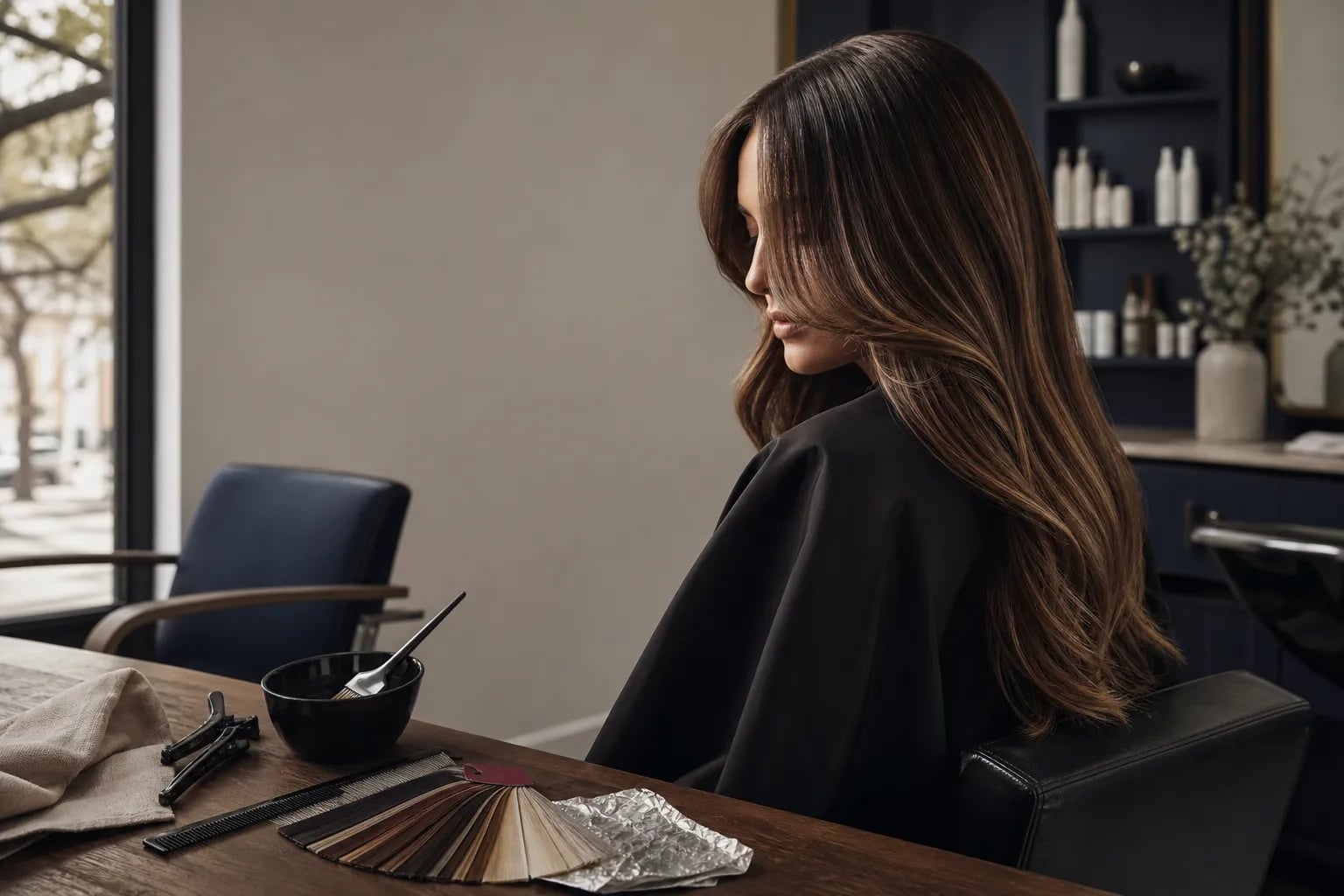
How long does a keratin treatment last on color-treated hair? On average, 2 to 4 months, compared to 3 to 6 months on untreated hair. Porosity is the primary driver of that gap, though washing frequency, product choices, and environmental exposure all play a role too. The more chemically processed your hair is, the more open and uneven the cuticle, and the faster each wash pulls the treatment out. As the owner of Harlow Beauty and Hair Salon on Burnet Road in North Austin, I can tell you that timing and longevity questions are the first things our color-treated and balayaged clients bring up before booking a keratin service. We do these services daily, so the guidance below comes from real-chair experience, not just theory.
What follows covers why color-treated hair holds keratin differently, whether the treatment affects your dye, how to sequence your appointments correctly, which formulas are gentler on chemically processed hair, and the aftercare routine that extends both your color and your smoothness as far as possible.
Key takeaways
- Realistic lifespan: Expect 2 to 4 months on color-treated hair, 6 to 10 weeks on heavily bleached or highlighted hair, and up to 6 months only on untreated, healthy hair.
- Porosity is the key variable: High-porosity, chemically processed hair absorbs and releases keratin faster than healthy, low-porosity hair, though washing frequency, heat styling, and product choices also affect how long results last.
- Color first, keratin second: Always color before your keratin service. Wait at least 7 to 14 days after standard color, and closer to 14 days (or per manufacturer guidance) after bleach or highlights, before your smoothing appointment.
- Toners and vivid shades fade fastest: Semi-permanent color, fashion shades, and toners are the most vulnerable to fading during keratin processing.
- Gentler formulas exist: Cysteine, amino acid, and glyoxylic acid-based treatments are better suited to chemically processed hair than traditional high-formaldehyde options.
- Aftercare is essential: Sulfate-free products, washing 2 to 3 times per week, and consistent heat protection are the biggest factors in extending your results.
How long does a keratin treatment last on color-treated hair: realistic timelines
Color-treated vs. untreated hair: what to expect
There are three tiers of results based on hair history, and knowing which one you fall into sets accurate expectations before you book. Untreated or minimally processed hair holds keratin the longest, typically 3 to 6 months, with coarse, dense hair often landing at the top of that range. Color-treated hair in good condition generally delivers 2 to 4 months of smooth results. Heavily bleached, highlighted, or repeatedly processed hair sits at the bottom of the spectrum, with results fading in as little as 6 to 10 weeks.
These are benchmarks, not guarantees. Washing frequency, product choices, and environmental factors like chlorine and humidity all shift where you land within those ranges. The client who washes twice a week and uses sulfate-free products will consistently outlast the client with the same hair history who washes daily with a clarifying shampoo.
Why porosity shortens keratin longevity on dyed hair
Bleaching and coloring lift the cuticle and create uneven porosity throughout the hair shaft. When a keratin treatment is applied to that surface, it absorbs inconsistently and exits the hair faster with each wash because the cuticle doesn’t close down as tightly as it would on untreated hair. Coarse, dense color-treated hair tends to hold the treatment longer than fine, high-porosity bleached hair, even when both clients receive the same service on the same day.
This is why two people sitting in adjacent chairs for the same keratin service can report completely different timelines at their next appointments. The treatment itself isn’t the variable, their chemical history going into the chair is.
Does a keratin treatment change your hair color?
How keratin processing affects dye
A keratin treatment doesn’t strip your color dramatically, but it can produce noticeable fading or a tonal shift. The pre-treatment clarifying wash, the chemistry of the treatment itself, and the high flat-iron heat all contribute to this effect, and the pigment that fades during processing is genuinely gone; it doesn’t reappear after the next wash. Repeated treatments or excessive heat can create cumulative color loss over time.
The risk is highest when color and keratin are performed close together, and the shift is more visible on porous or recently colored hair. Stable, older color that has fully oxidized handles keratin processing with much less drama than freshly applied dye.
Which hair colors are most vulnerable to fading
Semi-permanent dye, fashion colors, and vivid shades are the most susceptible because their pigment molecules sit at or near the cuticle surface rather than inside the hair shaft. Reds, coppers, pinks, purples, and pastels lose intensity the fastest. Toners on blonde or highlighted hair are especially at risk: the heat and clarifying steps can expose the yellow or brassy undertones the toner was covering, leaving the hair looking warmer or more golden than expected.
Permanent color is the most stable category because its pigment forms deeper in the cortex, but it can still appear lighter or warmer after keratin processing on porous hair. Demi-permanent color falls in the middle. If you’re maintaining a tone, a toner touch-up after the keratin has fully set is often the cleanest solution.
When should you color your hair: before or after a keratin treatment?
Color first, then keratin: the recommended order and timing
Coloring before the keratin service is the standard recommended sequence for a practical reason: the keratin treatment helps seal in fresh color rather than pulling it out. For healthy hair in good condition, most stylists and product manufacturers recommend waiting at least 7 to 14 days after coloring before the smoothing appointment. After bleach, highlights, or any fragile, damaged situation, lean toward the 14-day end of that window, or follow the keratin product manufacturer’s guidance and do a strand test, before exposing the hair to clarifying cleansers and high iron heat.
Fresh dye needs time to oxidize and fully settle into the hair shaft before the hair goes through the stress of a keratin service. Rushing that window risks uneven fading and, in the case of fragile bleached hair, potential integrity issues from layering chemical processes too closely together.
Getting color after a keratin treatment: how long to wait
If you want to color after a keratin service, wait a minimum of 2 weeks, and some formulas require up to 4 weeks before dye can be applied evenly. Applying color too soon means the keratin coating interferes with how dye distributes through the hair shaft, which can result in patchy, uneven results and accelerated fading afterward.
For same-day appointments where a client needs both services in one visit, color must always come first and keratin second. That sequence holds regardless of timing pressure.
Which keratin formulas work best on dyed or bleached hair?
Safer smoothing options for chemically processed hair
The formula categories best tolerated by color-treated hair include cysteine and amino acid-based treatments, glyoxylic acid formulas, and express or soft keratin options. These require lower processing temperatures and are gentler on a compromised cuticle than traditional high-formaldehyde formulas. A Brazilian Blowout or similar keratin-style smoothing treatment may also fall into this category depending on its specific formulation, so always ask for the full ingredient list rather than relying on the brand name alone. Results from gentler options may not last quite as long, but the tradeoff in hair integrity is worth it for anyone with a significant chemical history.
One important clarification: “formaldehyde-free” labeling alone isn’t a guarantee of gentleness. The actual ingredient list and the iron temperature used during application matter just as much as the marketing claim on the bottle. Before any smoothing service, ask for the product name, the full ingredient list, and the recommended iron temperature for your specific hair type.
What to ask your stylist before booking a keratin service
A qualified stylist should perform a strand test, assess the hair’s porosity and elasticity, and review your full chemical history before recommending a formula. That means bleach, relaxers, previous smoothing treatments, and current color are all part of the conversation. At Harlow Beauty and Hair Salon, stylists go through a client’s full color history before recommending any smoothing formula, specifically so the service works with the existing color investment rather than against it.
No keratin service is appropriate for hair that is gummy, actively breaking, or severely over-processed. If the hair can’t safely withstand the heat-sealing step, the right answer is a bond-building or conditioning treatment first, not a smoothing service.
What aftercare routine makes keratin results last longer on dyed hair?
Washing habits and product choices that protect both color and smoothness
The first 48 to 72 hours after the service are the most critical. Hair shouldn’t be washed, heavily wetted, or tied back during this window while the treatment sets. After that, washing 2 to 3 times per week rather than daily is one of the single most impactful habits for extending keratin results on color-treated hair. Every wash removes a small amount of both color and keratin; reducing wash frequency slows both losses simultaneously.
Product choice is the other major lever. A sulfate-free, color-safe shampoo reduces both color fade and keratin breakdown. A moisturizing conditioner applied from mid-lengths to ends at every wash is essential for dyed, porous hair. Add a hydration-focused mask once a week; avoid heavy protein masks that can make already-treated hair feel stiff or brittle over time.
Heat styling rules for color-treated keratin hair
Apply a dedicated heat protectant every single time before blow-drying or using a flat iron. For dyed or lightened hair, a practical upper limit on flat iron temperature is around 350 to 375°F, though always follow the keratin product manufacturer’s recommended iron temperature, which may differ by formula. Higher temperatures break down the keratin bond faster and risk further color shift on already-processed hair. Fewer passes with a moving tool are always better than slow, repeated passes over the same section.
Limiting hot-tool sessions to 2 to 3 times per week is a realistic target for clients with color-treated hair who want to preserve both their smoothness and their color between appointments.
Protecting results from chlorine, salt water, and friction
Before swimming, saturate your hair with fresh water and apply a leave-in conditioner to reduce how much chlorine or salt the hair absorbs. Rinse promptly after any pool or ocean exposure and cleanse gently. Dry your hair with a microfiber towel or a soft cotton T-shirt rather than rubbing with a rough terry towel, which creates friction and disrupts the cuticle.
Sleeping on a smooth pillowcase and keeping hair loose rather than in tight styles between washes reduces mechanical friction and helps both the color and the keratin treatment last longer between salon visits.
Making both your color and keratin go the distance
On color-treated hair, a keratin treatment typically delivers 2 to 4 months of smooth results, and that range is real. The right formula, proper appointment sequencing, and a consistent aftercare routine can push results toward the longer end. When both services are planned well and a stylist who understands color chemistry and smoothing treatments is guiding the process, they genuinely support each other rather than work against each other.
For Austin clients with balayage, highlights, or color-treated hair who want a keratin treatment that works with their color rather than against it, the team at Harlow Beauty and Hair Salon is the resource to reach out to. We review your full color history before recommending any smoothing formula, so your investment in color stays protected.
If you’re not sure which service is the right fit for your hair, take our stylist-matching quiz before booking. It’s the fastest way to find the right fit for your hair and your schedule. Reach out to our team to get started.
Frequently asked questions
How long does a keratin treatment last on color-treated hair compared to virgin hair?
On color-treated hair, keratin treatments typically last 2 to 4 months. On untreated or virgin hair, results can last 3 to 6 months. The difference comes down to porosity: chemically processed hair has a more open, uneven cuticle that releases the treatment faster with each wash.
Does keratin treatment fade hair color?
It can. The clarifying pre-wash, the treatment chemistry, and the high flat-iron heat used during the service all contribute to some color fading, particularly with semi-permanent shades, toners, and vivid fashion colors. Permanent color is more stable but can still appear slightly lighter or warmer afterward on porous hair.
How long should I wait after coloring before getting a keratin treatment?
Most stylists and product manufacturers recommend waiting 7 to 14 days after standard color before a keratin service. After bleach or highlights, lean toward the full 14 days, or follow the keratin product manufacturer’s specific guidance and do a strand test first.
Which keratin formula is safest for dyed or bleached hair?
Cysteine, amino acid, and glyoxylic acid-based formulas are generally the gentlest options for chemically processed hair. They work at lower temperatures and put less stress on a compromised cuticle than traditional formaldehyde-based treatments. Always ask your stylist for the full ingredient list, “formaldehyde-free” labeling alone doesn’t guarantee a gentle formula.
What products help keratin last longer on color-treated hair?
Use a sulfate-free, color-safe shampoo and a moisturizing conditioner at every wash. Add a hydration-focused mask once a week. Apply heat protectant before any hot-tool use. Avoid chlorinated or salt water without first saturating hair with fresh water and a leave-in conditioner.
Can I get a keratin treatment and color done on the same day?
Yes, but color must come first, always. Applying keratin after color on the same day is acceptable if your hair is in good condition. The reverse order is not: keratin creates a coating that prevents dye from distributing evenly through the hair shaft.