
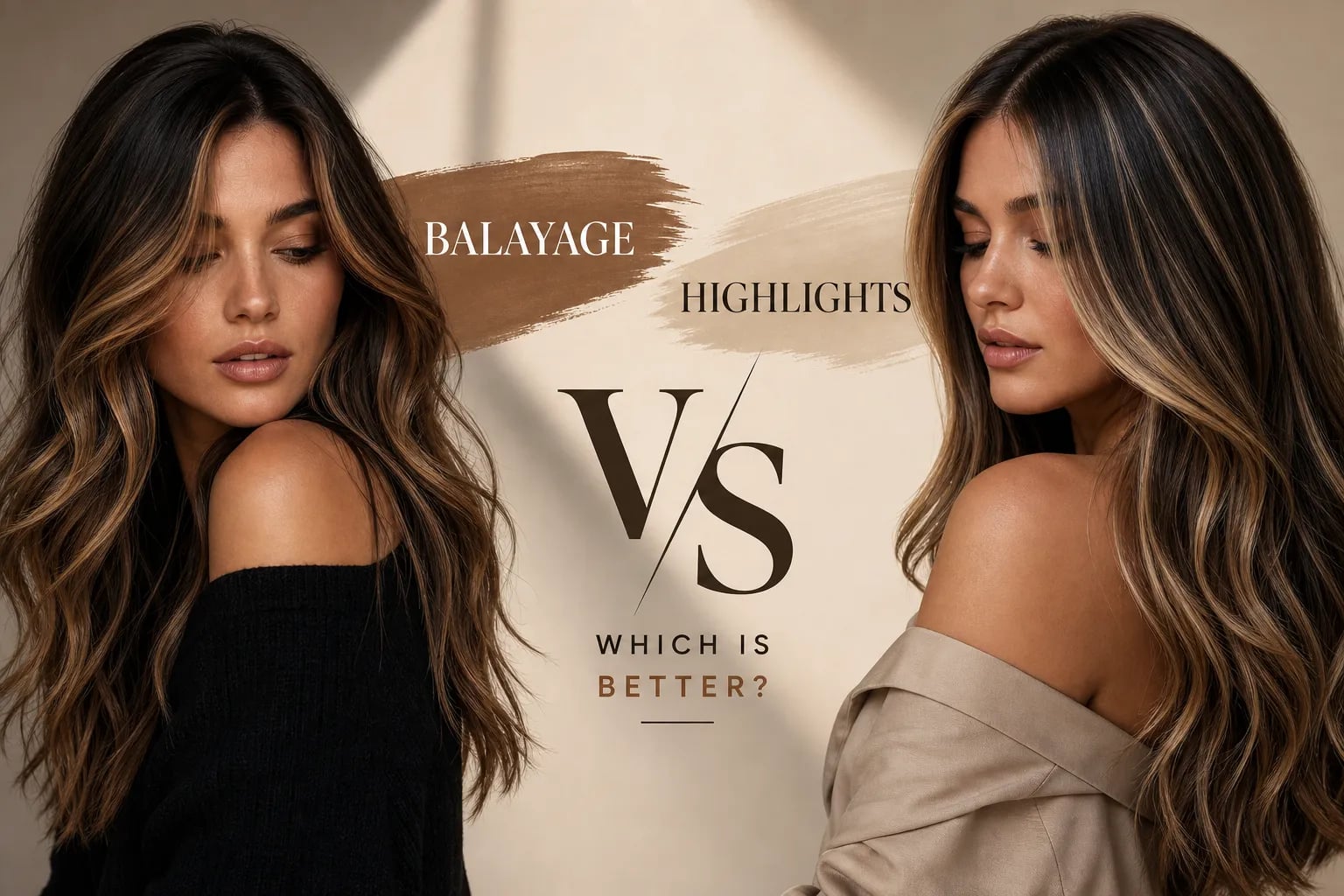
Balayage vs. highlights, which is better for brunettes? It’s one of the most common questions in the salon chair, and the answer isn’t as simple as most online advice suggests. You book a color appointment hoping for that soft, sun-kissed dimension you see on Pinterest. You walk out with either flat, single-toned brown hair or brassy stripes that fade within weeks. Many clients report that online color guidance feels written for blondes, leaving brunettes to piece together advice that doesn’t quite fit their hair.
The decision between balayage and highlights for brunettes isn’t obvious. The techniques behave differently on dark hair than they do on light, and the wrong choice can mean more maintenance, more brass, and more money spent on fixes than you planned for. This article breaks down exactly how each technique performs on brown hair, from lift and tone to grow-out and annual cost, so you can walk into your next appointment knowing what to ask for. The guidance reflects the approach used by stylists at Harlow Beauty and Hair Salon, who specialize in dimensional brunette color work in North Austin.
What actually separates balayage from foil highlights
The application method and how it shapes the result
Balayage is a freehand technique where lightener is painted directly onto the hair surface in sweeping strokes, with no foil involved. Because the product sits in open air, there’s less heat, which means a softer, more gradual lift. Foil highlights work differently: your colorist sections the hair, applies lightener, and wraps each section in aluminum foil. That foil traps heat, which speeds and intensifies the lift, giving the result more uniform brightness.
The practical difference comes down to control versus freedom. Foils give your colorist surgical precision, every strand that gets lightened is a deliberate choice. Balayage gives your colorist freedom of movement, allowing for more fluid, painterly placement that mimics how the sun would naturally lighten hair. Neither is better in the abstract. They’re just tools that produce different results.
Lift levels and where product lands on the hair
With balayage, lightener typically starts one to two inches from the root and concentrates on mid-lengths and ends. That placement is intentional: it produces a soft, lived-in gradient rather than a structured, root-forward result. Foil highlights can be placed root-to-tip, which delivers more even brightness and a higher-contrast outcome.
This distinction matters especially for brunettes. Brown hair contains strong underlying pigment, red and orange primarily, that has to be broken down before any lighter tone can show through. Getting a meaningful lift on brunette hair requires real processing time, and foils, with their trapped heat, are often more efficient at achieving dramatic lightening in a single session.
Balayage vs. Highlights for Brunettes: How Each Technique Behaves on Brown Hair
Contrast, dimension, and how the grow-out tells the story
Dark hair is actually a great canvas for balayage. The deeper base creates natural contrast against lighter painted pieces, producing soft, sun-kissed dimension without stripping the overall richness from the brown. The result tends to look like movement and depth rather than discrete stripes of color. Foil highlights on brunettes produce more visible, sharper contrast, which can read as bold, dramatic brightness when done well, or as visible banding and demarcation lines when placement or blending is off.
Grow-out is where the two techniques really diverge. Balayage, painted away from the root, blends seamlessly as new hair grows in. A root-smudge or shadow root technique amplifies this even further. Your colorist applies a slightly deeper tone at the root, then feathers it softly into the lighter lengths, creating a melted transition that makes new growth look intentional rather than neglected. Balayage grows out gracefully; foil highlights placed at the root show a visible line of demarcation, often within four to six weeks.
Tone and brassiness on a brunette base
Brunette hair carries warm undertones (red, orange, and gold) that become visible the moment lightener touches the hair. Balayage’s softer lift often lands in the amber-to-caramel range naturally, which can actually look beautiful on warm brunettes without much correction. Foil highlights, which push lift higher, are more likely to pull into brassy territory and typically need a toner to bring the result into the cool or neutral zone you’re likely picturing.
Both techniques benefit from a gloss or toner appointment, and you should budget for it as part of the service, not as an optional add-on. The difference is frequency and urgency: highlights often need toning sooner and more regularly, while brunette balayage can stretch gloss appointments to every six to eight weeks for many clients.
The real cost and time gap between the two techniques
What each service costs at a professional salon
Balayage typically runs $150 to $450 or more per session at a professional U.S. salon, with two to four hours in the chair. Foil highlights range from $75 to $350 and take one and a half to three and a half hours. Balayage costs more per appointment because the technique is highly customized: every brushstroke requires a judgment call about angle, pressure, and saturation. There’s no formula to follow, which means the result depends heavily on your colorist’s eye and experience.
Cost-per-appointment doesn’t tell the full story for anyone prioritizing low-maintenance hair color. Consider a practical example: two balayage sessions at $300 each totals $600 annually, while five highlight appointments at $150 each reaches $750, and that’s before toner visits. Over twelve months, the annual investment in balayage and highlights often evens out (or tips toward balayage) because of the longer intervals between full services. Paying more twice a year can absolutely be less than paying less four or five times.
How often you’ll actually be back in the salon chair
Brunette balayage typically needs a toner or gloss refresh every six to eight weeks to maintain tone, with a full balayage refresh every three to six months depending on grow-out visibility and your desired contrast level. Traditional highlights require maintenance more frequently, usually every two to three months, because root regrowth shows up sooner and more distinctly against a brunette base.
Between major services, many brunettes book periodic gloss appointments to refresh shine and tone without starting from scratch. This in-between gloss is worth building into your budget from the start. It’s less expensive than a full color service and keeps your result looking intentional rather than faded between visits.
Shades and placement that actually flatter brunette hair
Choosing the right shade family for your brunette base
Shade selection for brunettes starts with undertone, not trend. Warm brunettes, those with golden or reddish bases, typically look best with caramel, honey, or bronze pieces. These shades enhance what’s already there rather than fighting it. Cool brunettes, hair that leans ashy or mousy, are better served by ash, mushroom, or mocha tones that keep the result balanced and prevent unwanted warmth. Neutral brunettes tend to land well with caramel-bronde or soft warm-neutral blends that feel effortless in both warm and cool light.
Depth matters as much as shade family. Deeper brunettes often achieve a more cohesive result with bronze or caramelized pieces rather than a high-blonde finish, which can look disconnected from a very dark base. This is where a colorist’s eye carries more weight than any at-home color chart. At Harlow Beauty and Hair Salon, every brunette consultation begins with an evaluation of base tone and hair health before any formula is selected, the kind of individualized approach that separates dimensional, personalized color from a generic result.
Highlight placement for dark hair: face-framing vs. all-over
Face-framing placement is one of the most flattering strategies available for brunettes, and it’s often underestimated. Even subtle brightness concentrated around the face lifts the complexion, adds softness, and creates the impression of dimension without committing to all-over color. For round or square face shapes, vertical ribbons of lighter color placed near the temples and traveling downward through the lengths are especially effective because they create length and movement rather than width.
For brunettes who want brightness without high maintenance, a partial balayage with face-framing pieces often hits the sweet spot: enough light to feel like a transformation, placed strategically enough to grow out without drama. All-over foil highlights distribute brightness more evenly, which works well for those chasing a more dramatic shift toward lighter overall color.
Which is better for brunettes: balayage or highlights? How to decide what fits your life
When balayage is the better call for brunettes
Balayage is the stronger choice when soft, dimensional color with a seamless grow-out is the goal. If you can realistically make it to the salon every three to four months, want a sun-kissed or lived-in finish rather than stark brightness, or you’re starting from a dark base and don’t want to go dramatically light all at once, balayage is built for you. It’s also the better option when brunette richness, depth, and movement matter more to you than uniform brightness from root to tip.
When foil highlights make more sense
Foil highlights are the better call when you want high contrast and noticeably brighter results, when you’re starting very dark and need significant lift in a single session, or when your end goal is closer to full blonde or a substantial color shift. They’re also worth choosing when you want very precise placement, such as babylights or a structured stripe pattern, that freehand painting can’t reliably replicate.
Questions to bring to your colorist before you book
The checklist that changes your appointment outcome
Going in prepared shortens the gap between what you picture and what you leave with. Before booking, know your answers to these four questions: How often can you realistically make it to the salon? What is your budget per visit versus per year? Do you want to maintain your brunette base or gradually lighten over time? What photos do you have of results you genuinely love, not just results that look good on someone else?
These aren’t just nice-to-haves. A colorist who asks these questions before touching your hair is following professional best practice. One who skips them is guessing. The photo reference is especially important for brunettes because “light” and “warm” mean very different things to different people, and showing your colorist is always faster than describing.
Why the consultation is where great brunette color starts
The best brunette color outcomes, the ones that look effortless in person and in photos, grow out beautifully, and don’t need constant correction, start with a thorough consultation, not just a technique selection. At Harlow Beauty and Hair Salon in North Austin, every color service begins with a consult-first process: your stylist evaluates your base tone, hair health, lifestyle, and goals before a single formula is mixed. New clients are even matched with a colorist suited to their hair goals before the first appointment is booked, which removes a layer of guesswork before you ever sit down.
That level of customization is what separates color you love from color you’re trying to fix three months later. Knowing whether balayage or highlights is right for your brunette hair is just the starting point. A skilled consultation turns that knowledge into a result that actually works for your hair, your schedule, and your life.
So which is better for brunettes?
When it comes to balayage vs. highlights, which is better for brunettes, the honest answer is that it depends on what you want your hair to do. Balayage delivers soft, dimensional color and a seamless grow-out on brunette hair; foil highlights deliver higher contrast, faster lift, and more structured brightness. Neither is universally better. The right choice depends on your brunette base, how often you want to be in the salon, and what you want your hair to do for you every single day.
Bring your shade preferences, your lifestyle reality, and your inspiration photos to a colorist who will actually sit down with you before picking up a brush. If you’re in North Austin and ready to figure out which approach fits your brunette hair goals, get in touch with the team at Harlow Beauty and Hair Salon to book a consultation. That conversation is where great color actually begins.